The legality of crypto gambling in India. Expert insights on USDT betting, taxes, bank risks, and offshore regulations.

Is Crypto Gambling Legal in India in 2026?


Crypto Legal Gambling: The Digital Frontier of Indian Wagering
In my decade-long journey through the corridors of the global iGaming industry, spanning four years at Entain and another four at Flutter Entertainment, I have witnessed several tectonic shifts. However, none have been quite as complex or as misunderstood as the rise of crypto gambling in India. As a Senior Market Analyst who has spent years dissecting player behavior from Mumbai to London, I’ve seen the Indian market transition from simple offshore websites to sophisticated, blockchain-powered platforms.
For the average Indian player, the intersection of Bitcoin and betting isn’t just a technical novelty; it is a practical response to a friction-filled traditional banking system. When I was completing my journalism degree at Mumbai University, the idea of an instantaneous, cross-border payment that bypassed traditional bank scrutiny seemed futuristic. Today, it is the reality for thousands of players across the subcontinent. As the co-founder of JeetBetter, my goal is to bring transparency to this “grey market,” helping you understand not just how to play, but how to stay on the right side of the law and protect your hard-earned winnings.
How the System Works: Blockchain Meets the Betting Slip
To understand the legality of crypto betting, you must first understand the technical plumbing that makes it possible. Crypto gambling platforms operate by replacing traditional fiat currencies (like INR) with Virtual Digital Assets (VDAs) such as Bitcoin (BTC), Ethereum (ETH), or Tether (USDT).
The Role of Decentralized Ledgers
In a traditional online casino, your deposit is processed by a payment gateway that must comply with local banking regulations. In a crypto casino, the transaction occurs on a blockchain a decentralized public ledger. This means there is no central authority in India that can “stop” the transaction in real-time. For a market analyst specializing in payment infrastructure, this is a fascinating bypass of the traditional “Merchant Category Codes” that often lead to declined transactions on Indian credit cards.
Smart Contracts and Provable Fairness
Many modern crypto betting sites use “Smart Contracts” to execute bets. This technology automatically pays out winnings once a certain condition is met, reducing the risk of a casino refusing to pay. Furthermore, “Provably Fair” algorithms allow players to verify the randomness of every spin or hand using cryptographic hashes. This level of transparency is something I frequently highlight when reviewing mathematical models from providers like Play’n GO or Nolimit City.
How Players in India Use It: The Crypto Workflow
Navigating the crypto gambling world in India requires a bit more “tech-savviness” than a standard UPI deposit. Based on my observations of player behavior, the process typically follows a three-step cycle.
The Acquisition Phase
Indian players rarely own crypto specifically for gambling. Instead, they use local exchanges or Peer-to-Peer (P2P) marketplaces to convert INR into USDT. I’ve noticed a significant preference for USDT (TRC-20) because the transaction fees are minimal compared to the Ethereum network, making it ideal for the high-volume, low-margin nature of sports betting.
The Deposit and Gameplay
Once the player has crypto in a private wallet, they transfer it to the offshore casino’s address. Because these platforms are hosted overseas , they offer a wider variety of games than what might be found locally, including high-volatility slots that I personally enjoy, such as those with Megaways engines.
The Withdrawal and Exit
The “exit” is where the legal questions often arise. Players withdraw their crypto winnings back to a private wallet and then sell that crypto for INR via P2P exchanges. This ensures that the bank only sees a transfer from another individual, rather than a direct payment from a gambling entity. Crypto casino withdrawal should not be taken lightly and planning is required to be on the safe side.
Comparison of Legal Risks: Traditional vs. Crypto Gambling in India
| Feature | Traditional Online Betting (INR) | Crypto Gambling (BTC/USDT) |
|---|---|---|
| Payment Method | UPI, NetBanking, Cards | Blockchain Transfer |
| Bank Visibility | High (Direct betting links) | Low (P2P Transfers) |
| Indian Tax Liability | 30% on Winnings | 30% on VDA Gains |
| Legal Status | Grey Market (State Dependent) | Grey Market (VDA Regulated) |
| TDS Requirement | 30% deducted by operator | 1% on VDA Transfer (Exchanges) |
| Player Protection | Minimal (Offshore) | Cryptographic/Provably Fair |
Safety and Risk Considerations: Protecting Your Digital Purse
While I often apply analytical rigor to cricket statistics for the Mumbai Indians, I apply even more to the safety protocols of iGaming platforms. The biggest risk in the crypto gambling world isn’t the legality, it’s the lack of recourse.
1. The “Exit Scam” Risk Since these sites are outside the jurisdiction of Indian courts, if a site decides to shut down and take your crypto, there is no legal avenue for recovery. I always advise JeetBetter readers to stick with brands that have a “Professional Pedigree” and have been active at major summits like SPiCE India or ICE London.
2. Regulatory Volatility The Indian government’s stance on crypto can change overnight. A new circular from the RBI or a change in the Finance Act can suddenly make it difficult to off-ramp your winnings into INR. This “regulatory volatility” is a key metric I track as a Senior Market Analyst.
Legal and Regulatory Context in India (2026)
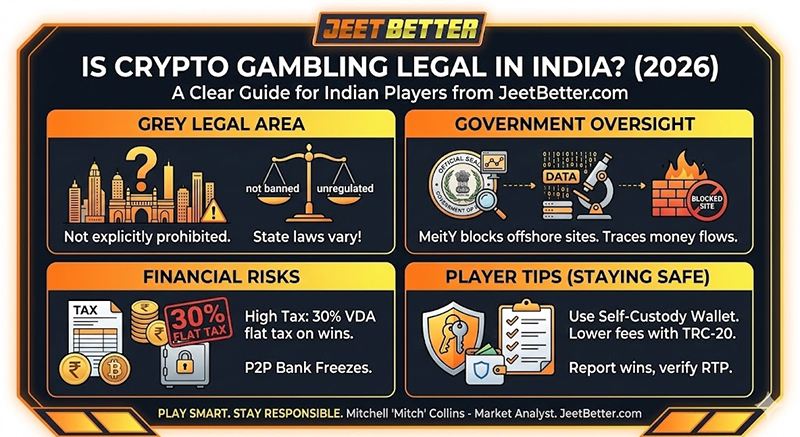
As of 2026, the legal framework for crypto gambling in India is essentially a “grey area within a grey area.” There is no federal law that explicitly says “it is illegal to gamble with Bitcoin”. The Public Gambling Act of 1867 focuses on physical gaming houses and does not contemplate digital assets or the internet.
However, the Information Technology Act and the recent VDA (Virtual Digital Asset) tax laws have created a secondary layer of regulation. While the act of betting itself might not be prosecuted, the financial movements associated with it are heavily monitored. The Indian government treats crypto as a taxable asset, and failing to report “Income from Other Sources” derived from gambling can lead to significant legal trouble with the Tax Department.
Common Questions Players Ask
Is crypto gambling legal in India in 2026?
As we navigate 2026, the legality of crypto gambling in India remains in a significant “grey zone.” No specific federal legislation explicitly bans or permits the use of cryptocurrency for online betting. While the Public Gambling Act of 1867 prohibits “common gaming houses,” it is silent on digital platforms. Essentially, while the government has not made it a criminal offense for an individual to play on an offshore site, they have also not provided a regulated framework to protect players. This means that while you likely won’t face arrest for placing a bet, you are operating in a space where you have no legal consumer protection if a dispute arises with the operator.
Can Indian players legally use crypto casinos hosted overseas?
Yes, Indian players frequently use crypto casinos hosted in overseas jurisdictions like Curacao or Malta. Since these platforms operate outside Indian territory, they do not fall under the direct jurisdiction of Indian gambling laws. However, the Foreign Exchange Management Act (FEMA) governs how money moves out of the country. Using cryptocurrency can sometimes circumvent these restrictions because it doesn’t involve a traditional “remittance” through the banking system. Nevertheless, the government can block access to these websites under the IT Act if they are found to be operating in violation of local policies, which is a risk every offshore player must accept.
Is it illegal to gamble online using Bitcoin or USDT in India?
There is no law in India that specifically categorizes gambling with Bitcoin or USDT as an “illegal” act. The legal system focuses more on the act of gambling rather than the currency used. However, the use of USDT for gambling exists in a regulatory vacuum. While you aren’t violating a specific criminal statute by using these tokens, you are interacting with Virtual Digital Assets (VDAs) that the Indian government views with extreme caution. The primary risk isn’t the “currency” itself, but the possibility that the platform you are using isn’t licensed or that you fail to report the resulting gains to the tax authorities.
Are offshore crypto betting sites legal for Indian users?
Offshore crypto betting sites are not “illegal” for Indians to access, but they are “unregulated”. This distinction is vital for any serious player to understand. An unregulated site means that the Indian government does not oversee its fairness, its payout capabilities, or its security protocols. While many of these sites are legitimate and licensed in their home countries, they are effectively invisible to the Indian legal system. If you choose to use them, you are entering into a private contract with an overseas entity. My advice as an analyst is to always verify the site’s history and licensing before sending any crypto, as you will have no local legal recourse if things go wrong.
Can my bank account get frozen if I withdraw crypto gambling winnings?
Your bank account can absolutely be frozen if the transaction used to “off-ramp” your crypto winnings is flagged. This usually happens during the P2P (Peer-to-Peer) process. If the individual sending you INR for your crypto is suspected of fraud, money laundering, or other illicit activities, your account may be frozen as part of a wider investigation. Banks in India are increasingly sensitive to crypto-related transactions and often use automated systems to flag accounts that receive multiple transfers from varied P2P sources. To minimize this risk, always use reputable exchanges with “Verified Merchants” and avoid mentioning “gambling” or “casino” in any transaction remarks or notes.
Do Indian players have to pay tax on crypto gambling winnings?
Yes, the tax obligations for Indian players are very clear and quite heavy. Since 2022, the Indian government has imposed a 30% flat tax on any income derived from the transfer of Virtual Digital Assets (VDAs). This includes winnings from crypto gambling. Furthermore, you cannot “set off” your losses against your wins. For example, if you win 1 Lakh in Bitcoin but lost 50,000 INR earlier in the week, you must still pay the 30% tax on the full 1 Lakh win. Failing to declare these earnings in your Income Tax Return (ITR) can result in severe penalties, including interest and potential prosecution for tax evasion.
How does the Indian government regulate crypto gambling?
Currently, the Indian government does not regulate crypto gambling directly; instead, it regulates the “crypto” and the “taxes”. By bringing crypto exchanges under the Prevention of Money Laundering Act (PMLA) and introducing the 30% VDA tax, the government has created a system where they can monitor the financial flows without actually “legalizing” the activity itself. This “regulation by taxation” approach allows the government to collect revenue and track high-value transactions. For the gambling aspect, the government occasionally blocks offshore betting sites that they deem a threat to public order or those that do not comply with local advisory notices.
Can Indian players deposit crypto into online casinos legally?
The act of depositing crypto into an online casino is not specifically prohibited by Indian law. However, the source of that crypto matters. If you are using a self-custody wallet to send funds to a licensed offshore casino, you are operating in the aforementioned grey area. The “legality” becomes more of a concern if you are using an Indian exchange to send funds directly to a casino wallet. Many Indian exchanges have internal policies that block transactions to known gambling addresses to stay in the good graces of the RBI. To remain compliant and avoid account bans, most experienced players use a “buffer” wallet—sending funds from an exchange to a personal wallet, and then to the casino.
Is using USDT for gambling allowed in India?
Using USDT for gambling is not “allowed” in the sense of being officially sanctioned, but it is also not strictly “disallowed”. USDT is a “Stablecoin,” and the Indian government treats it as a Virtual Digital Asset. Therefore, it falls under the same 30% tax rule as Bitcoin. From a practical standpoint, USDT is the preferred method for many Indian gamblers because it avoids the price volatility of other coins. However, the legal risks remain the same: if the platform is unlicensed or if the P2P conversion back to INR triggers a bank alert, you could face administrative or financial hurdles. It is a tool for privacy and speed, not a “get out of jail free” card regarding Indian financial regulations.
What laws apply if I gamble on a crypto casino outside India?
If you gamble on a site hosted outside India, you are primarily subject to the laws of the country where the casino is licensed (e.g., Curacao) and the terms and conditions of that specific platform. However, your financial conduct remains subject to Indian laws like the Income Tax Act and the Foreign Exchange Management Act (FEMA). If you win a large sum, the Indian government will expect their 30% share of the “VDA transfer”. Furthermore, if the government decides a particular site is harmful, they can use the IT Act to block your access to it. You are essentially bridging two legal worlds: the digital, offshore world of the casino and the physical, onshore world of your Indian bank account and tax residency.
Can Indian crypto exchanges block gambling related transactions?
Yes, Indian crypto exchanges can and often do block transactions that they identify as being linked to gambling. To comply with anti-money laundering (AML) and “Know Your Customer” (KYC) guidelines, these exchanges use sophisticated blockchain analysis tools to track where funds are going. If an exchange identifies a destination address as belonging to a major gambling bot or offshore casino, they may block the transfer or, in extreme cases, freeze your account. This is why many analysts recommend using a private, non-custodial wallet (like MetaMask or Trust Wallet) as an intermediary step. By moving your funds to your own wallet first, you maintain control and reduce the risk of an exchange interfering with your play.
Are Telegram crypto casinos legal for players in India?
Telegram crypto casinos occupy the most ambiguous space in the current market. Because they operate via bots within an encrypted messaging app, they are very difficult for regulators to track or block. Legally, they fall under the same offshore “grey area” as web-based casinos. However, the risk for the player is much higher. Many Telegram bots are “scam bots” that have no license and no physical presence. While using them isn’t “more illegal” than using a website, the chances of losing your money to a fraudulent operator are significantly increased. Always look for bots that are officially verified by a recognized gaming authority or recommended by a trusted community like JeetBetter.
Can Indian players withdraw crypto casino winnings to bank accounts?
You cannot withdraw cryptocurrency directly from a casino to an Indian bank account because banks do not accept “crypto” deposits; they only accept “INR”. To get your winnings into your bank account, you must convert the crypto into INR through a third party. This is usually done via a P2P exchange. You send your crypto winnings to the P2P platform, find a buyer who wants to pay in INR, and they transfer the money directly to your bank account via UPI or IMPS. Once you confirm receipt of the funds, the platform releases the crypto to the buyer. This process is legal, provided you report the income and pay the necessary taxes on the VDA transfer.
Is crypto sports betting legal in India?
Crypto sports betting is treated the same way as crypto casino gaming—it is a grey market. There is no federal law that prohibits betting on cricket or football using Bitcoin. However, some Indian states, like Telangana, Andhra Pradesh, and Tamil Nadu, have passed their own specific laws to ban all forms of online gambling, regardless of the currency used. If you are located in one of these “restricted” states, participating in crypto sports betting could be seen as a violation of state-level statutes. For players in other states, the lack of federal regulation means you can technically access these platforms, but you must remain diligent about your tax obligations.
Do crypto casinos require KYC verification for Indian players?
One of the main draws of crypto casinos is the “No-KYC” or “Light-KYC” model. Many platforms allow you to sign up and play using only an email address, providing a level of privacy that traditional casinos do not. However, my experience at Flutter and Entain shows that “No-KYC” is rarely permanent. Almost every reputable platform will eventually trigger a KYC request if you try to withdraw a large sum or if your account shows suspicious activity. They will ask for proof of identity (like a Passport or Aadhaar card) to comply with international AML standards. If a site never asks for KYC even for huge wins, it is actually a red flag, as they may be operating without any regulatory oversight at all.
Can the Indian government track crypto gambling transactions?
The Indian government has significantly improved its ability to track crypto transactions. While blockchain transactions are “pseudonymous” (tied to a wallet address rather than a name), the “on-ramps” and “off-ramps” (exchanges) are highly regulated. If you use an Indian exchange to buy crypto, that exchange has your KYC data. If you then move that crypto to a casino and back to the exchange to cash out, the government can link those movements. Furthermore, the FIU-IND (Financial Intelligence Unit) has specialized tools to trace transactions across public blockchains. While they might not track every small bet, they are certainly monitoring large-scale movements of value into and out of the country, especially those involving P2P transfers.
Are no-KYC crypto casinos safe for Indian players?
The safety of no-KYC casinos is a double-edged sword. On one hand, they protect your privacy and prevent your gambling habits from appearing on your official ID records. On the other hand, a casino that doesn’t care who you are often doesn’t care about their own reputation either. As an analyst, I’ve seen many no-KYC sites “vanish” with player funds because they have no accountability to a regulator. If you choose to use a no-KYC platform, you should never keep a large balance on the site. Withdraw your winnings immediately and only play with what you are prepared to lose. True safety comes from the platform’s “Provable Fairness” and its track record in the community, not just its lack of paperwork.
What risks do Indian players face when using crypto casinos?
Indian players face three primary risks: financial, legal, and regulatory. Financially, the biggest risk is “Platform Insolvency”, if the offshore casino goes bust or is a scam, your money is gone with no hope of recovery. Legally, the risk is failing to comply with the 30% VDA tax or the 1% TDS, which can lead to high-interest penalties or legal action from the CBDT. Regulatorily, there is the risk of “Bank Account Freezes” if your P2P transactions are linked to suspicious third parties. To mitigate these, you must be meticulous with your records, use only trusted platforms, and treat crypto gambling as a high-risk, high-reward activity that requires constant vigilance.
How do Indian players convert crypto gambling winnings into INR?
Converting winnings into INR is almost always done via the P2P (Peer-to-Peer) market. After winning, you withdraw the crypto to a wallet and then transfer it to a major exchange like Binance or Bybit. You then go to the “P2P Trading” section, select “Sell,” and choose “INR” as the fiat currency. You will see a list of buyers offering to pay via UPI, IMPS, or PhonePe. You choose a buyer, they send the money to your bank account, and you “Release” the crypto to them through the exchange’s escrow system. It is a reliable process, but I always recommend choosing buyers with a high “completion rate” (over 95%) and a large number of trades to ensure a smooth and safe transaction.
What happens if a crypto casino refuses to pay Indian players?
If an offshore crypto casino refuses to pay, you have almost no legal “teeth” within India. You cannot report them to the Consumer Forum or the RBI because they are not Indian entities. Your only real recourse is to use the power of the “iGaming Community.” You can file a complaint with their licensing authority (if they have one, like the Curacao Gaming Control Board) or post your experience on global review sites like AskGamblers or Casinomeister. Often, reputable casinos will resolve a dispute to avoid the negative PR. However, if the site is a “fly-by-night” operation with no license, your funds are likely lost. This reinforces why “due diligence” on the operator’s pedigree is the most important step before you even place your first bet.
Practical Tips for Players: Navigating the 2026 Grey Market
As a journalist who has spent years “bridging the gap” between data and reporting, I’ve developed a set of “Golden Rules” for anyone entering the crypto gambling space in India.
- The “Intermediary Wallet” Rule: Never send funds directly from an Indian exchange to a casino. Use a private wallet (like Trust Wallet or MetaMask) as a middleman. This keeps your exchange account safe from being flagged for “gambling activity”.
- Tax Honesty: Keep a simple spreadsheet of your wins and losses. In 2026, the Indian tax department is using AI to find discrepancies in bank deposits. It’s better to pay the 30% tax on your gains than to pay a 100% penalty later.
- Use TRC-20 for USDT: When moving money, always select the Tron (TRC-20) network if the casino supports it. The “gas fees” are usually just $1, compared to the $10-$20 fees you might see on the Ethereum network.
- Verify the License: Look for the validator logo at the bottom of the casino homepage. Click it—it should lead to an official page from a regulator (like Curacao or Anjouan) confirming the license is active.
Bank Account Hygiene: If you are withdrawing large amounts via P2P, consider using a separate bank account specifically for your crypto activities. This ensures that if the account is ever “frozen” for investigation, your main salary or household account remains accessible.
Final Thoughts: The Future of Crypto Betting in India
The landscape of crypto gambling in India is a perfect example of “Technology outpacing Legislation.” As a Senior Market Analyst, I believe that the government will eventually have to move beyond “regulation by taxation” and create a formal framework for online betting to protect its citizens.
Until that day, the burden of safety lies with you. Crypto offers a world of fast payouts, anonymous play, and access to incredible games like Andar Bahar or Cluster Pays slots. But it also requires you to be your own “compliance officer.” Stay informed, use the tools we provide at JeetBetter, and remember that in the world of crypto, your security is only as good as your own diligence.
Top – Indian Casinos

150% Welcome Bonus up to ₹40,000

Welcome bonus offering 100% up to €600/$600

350% bonus of up to ₹70,300

Get 200% Welcome Bonus up to ₹1 Lakh + ₹500 Free Bet

Get 100% up to ₹25,000 bonus on your first deposit.

200% welcome bonus on their first deposit up to ₹1,00,000




Top Rated Casinos
200% welcome bonus on their first deposit up to ₹1,00,000
Get 200% Welcome Bonus up to ₹1 Lakh + ₹500 Free Bet
Get 100% up to ₹25,000 bonus on your first deposit.
150% Welcome Bonus up to ₹40,000
Welcome bonus offering 100% up to €600/$600
350% bonus of up to ₹70,300