

Crypto Betting: The Digital Transformation of the Indian Gamble
In my decade-long journey through the corridors of the global iGaming industry, spanning four years at Entain and another four at Flutter Entertainment, I have witnessed several “gold rushes.” However, none have been quite as transformative or as misunderstood as the rise of crypto betting in India. As a Senior Market Analyst who has spent years dissecting player behavior from Mumbai to London, I’ve seen the Indian market evolve from back-alley physical dens to sleek, blockchain-powered platforms that offer unprecedented privacy and speed.
For the average Indian player, the appeal of a crypto betting isn’t just about the “cool factor” of Bitcoin or Ethereum. It is a practical response to a friction-filled traditional banking system. When I was finishing my journalism degree at Mumbai University, the idea of an instantaneous, cross-border payment that bypassed traditional bank scrutiny was a dream. Today, it is a reality that thousands of Indian players use daily to access their favorite games, from high-volatility Megaways slots to local classics like Andar Bahar Casino and Teen Patti Cash.
At JeetBetter, our mission is transparency. In this deep dive, I want to use my “behind-the-curtain” experience to explain exactly how these platforms work, the risks you genuinely need to worry about, and how to navigate the complex regulatory and tax landscape of India in 2026.
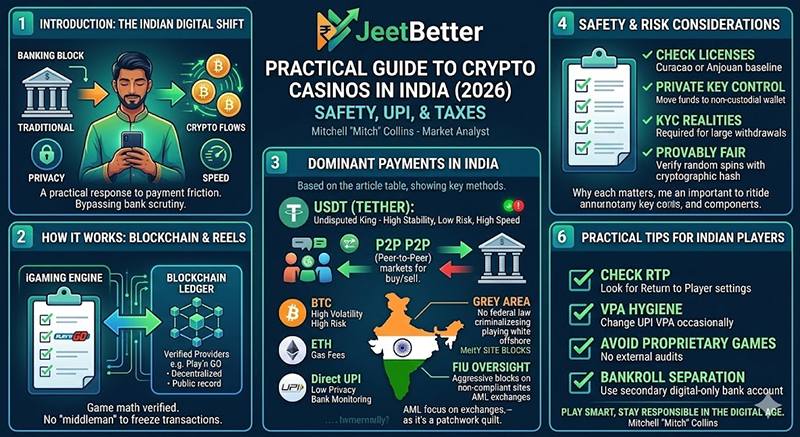
How the System Works: Blockchain Meets the Reel
To understand a crypto betting, you have to look past the flashing lights and realize it is a sophisticated marriage of two technologies: the iGaming Engine and the Blockchain Ledger.
The iGaming Engine
Traditional online casinos rely on central servers to run games. In a crypto betting, the front-end remains similar—you’ll still see titles from world-class providers like Play’n GO or Nolimit City. These games are hosted on the providers’ servers, ensuring that the casino itself cannot “flip a switch” to make you lose. My experience at Flutter taught me that the integration of these APIs (Application Programming Interfaces) is the backbone of trust. If a casino uses recognized providers, the game math is verified.
The Blockchain Ledger
The “crypto” part comes into play during the transaction phase. Instead of a bank processing your deposit, the transaction is recorded on a public blockchain (like Bitcoin, Ethereum, or Tron). This decentralization means there is no “middleman” to freeze your transaction because they don’t approve of gambling. For an analyst focusing on payment infrastructure, this is a game-changer for the Indian market, where traditional “Merchant Category Codes” (MCC) often trigger automatic rejections by major Indian banks.
How Players in India Use It: Navigating the Friction
In my years of analyzing UA (User Acquisition) strategies in high-competition regions, I’ve noticed that Indian players are some of the most adaptable in the world. When one door closes—such as a bank blocking a direct transfer to a betting site—Indian players find a side door through crypto.
Deposits: The USDT Dominance
While Bitcoin is the “famous” one, USDT (Tether) is the undisputed king of Indian crypto gambling. Players use local exchanges or P2P (Peer-to-Peer) markets to buy USDT and then send it to the casino. This avoids the massive price swings (volatility) of Bitcoin while maintaining the benefits of blockchain.
Withdrawals: The P2P Exit Strategy
The biggest concern I hear at summits like SPiCE India is about getting the money back into a “spendable” form. Indian players rarely withdraw directly to a bank. Instead, they withdraw their crypto casino winning to a private wallet, then move those funds to a P2P exchange where they can trade their crypto for INR directly into their bank account from another individual, keeping the transaction “off the radar” of the casino’s direct payment processors.
| Method | Speed | Privacy | Ease of Use (India) | Risk Level |
|---|---|---|---|---|
| Bitcoin (BTC) | 10–60 mins | High | Medium (High Volatility) | Moderate |
| Tether (USDT – TRC20) | 2–5 mins | High | High (Stable Value) | Low |
| Ethereum (ETH) | 5–15 mins | High | Medium (High Gas Fees) | Moderate |
| Direct UPI (P2P) | Instant | Low | High | High (Bank Monitoring) |
Safety and Risk Considerations: Beyond the Hype
As an analyst who has managed risk for global giants, I cannot stress this enough: Not all crypto casinos are created equal. The same anonymity that protects your privacy also protects scammers.
1. The Ghost Casino Risk
Because it is relatively easy to set up a website that accepts crypto, we see “pop-up” casinos that operate for six months, collect deposits, and then disappear. I always tell my readers at JeetBetter to check for a “Professional Pedigree”, does the casino have a license from Curacao or Anjouan? While these aren’t as strict as the UK Gambling Commission, they provide a baseline of accountability.
2. The Private Key Danger
In the world of crypto, your “private key” is your money. If you store your gambling funds on a casino’s internal wallet for too long, you are at the mercy of their security. My advice? Only keep what you intend to play with on the platform. Move your winnings to a “non-custodial” wallet like MetaMask or Trust Wallet immediately.
Legal and Regulatory Context in India (2026)
The Crypto casino legal landscape in India is a patchwork quilt of outdated laws and modern digital mandates. As of 2026, there is no federal law that makes playing at an offshore crypto betting a crime. The Public Gambling Act of 1867 remains the central pillar, and it is silent on the matter of digital assets.
However, the Ministry of Electronics and Information Technology (MeitY) has become more aggressive in blocking offshore crypto betting sites that don’t comply with local tax laws. Furthermore, the Financial Intelligence Unit (FIU) has brought several offshore crypto exchanges under the ambit of the Prevention of Money Laundering Act (PMLA). For the player, this means that while playing isn’t illegal, moving the money is becoming more transparent to the government.
Common Questions Players Ask
The legality of crypto casinos in India in 2026 remains a complex “grey area.” There is no specific federal law that prohibits an individual from using their cryptocurrency to play on an offshore platform. The Indian government has focused its regulatory efforts on taxing the gains (30% tax on Virtual Digital Assets) and requiring exchanges to register with the FIU-IND, rather than criminalizing the act of gambling itself. However, because these platforms are offshore, they are not regulated by Indian authorities, meaning you play at your own risk without the protection of Indian consumer courts. It is essential to understand that while it may not be “illegal” to play, the platforms themselves are often operating outside the direct supervision of Indian gaming laws.
Yes, you can use UPI to deposit, but it usually involves an intermediate step rather than a direct transfer to the casino’s bank account. Most Indian players use UPI on a P2P (Peer-to-Peer) exchange like Binance or Bybit to purchase USDT or Bitcoin first. Once the crypto is in their exchange wallet, they transfer it to the casino. Some casinos offer a “Direct UPI” option, which uses a local P2P node—essentially, you pay a local individual via UPI, and the casino credits your account with the equivalent crypto. However, I advise caution with direct UPI-to-casino transfers, as they leave a clear “paper trail” in your bank statement that could lead to your account being flagged by bank compliance algorithms.
Your bank will not freeze your account simply for receiving money, but they might freeze it if they detect a pattern of suspicious P2P transactions linked to “high-risk” activities. When you convert crypto winnings back to INR via P2P markets, you are receiving money from another individual’s bank account. If that individual’s account is later flagged for suspicious activity or money laundering, every account they sent money to, including yours, could be temporarily frozen during an investigation. To minimize this risk, always use highly-rated P2P “merchants” with thousands of completed trades and a high success rate. Avoid receiving multiple small payments from many different people; instead, try to consolidate your withdrawals into fewer, cleaner transactions with verified users.
The safest way for Indian players to convert winnings to INR is to use a reputable, FIU-compliant exchange. First, withdraw your winnings from the casino to a private, non-custodial wallet (like Trust Wallet). From there, send the funds to a major exchange. You can then use the exchange’s P2P desk to sell your crypto to a “Verified Merchant” who will send INR to your bank account via IMPS or UPI. By using a private wallet as a “buffer” between the casino and the exchange, you prevent the exchange from seeing that the funds originated from a gambling site, which helps protect your exchange account from being closed due to their internal anti-gambling policies.
The requirement for KYC (Know Your Customer) varies significantly depending on the casino’s licensing and internal risk policies. Many “Pure Crypto” casinos advertise a “No-KYC” experience, allowing you to play and withdraw smaller amounts using only an email address. This is a huge draw for Indian players seeking privacy. However, my experience at Entain and Flutter confirms that almost all legitimate operators will eventually trigger a “Security Check” if you attempt to withdraw a large sum (e.g., over $2,000) or if their system detects suspicious betting patterns. They may ask for a scanned copy of your Aadhaar card or PAN card. If a casino never asks for KYC even for massive wins, be careful—it could be a sign that they don’t intend to pay out large winners at all.
In 2026, the Indian tax code is very clear regarding Virtual Digital Assets (VDAs). Any income derived from the transfer of crypto assets is taxed at a flat rate of 30%, plus applicable surcharges and cess. Crucially, you cannot set off losses from one crypto transaction against gains from another. This means if you win 10,000 INR in Bitcoin but lost 5,000 INR earlier that day, you are still taxed on the full 10,000 INR win. Additionally, a 1% TDS (Tax Deducted at Source) is often applicable on sell transactions on Indian exchanges. It is your responsibility to report these gains under “Income from Other Sources” when filing your ITR. Ignoring these taxes can lead to heavy penalties if the Income Tax department tracks the INR deposits into your bank account.
While you can use Binance to send funds to a casino, it is a practice I generally advise against. Most major centralized exchanges, including Binance, have strict “Terms of Service” that prohibit transactions to and from gambling sites. Their automated systems can often identify the wallet addresses of major crypto betting and casino sites. If Binance flags your transfer as gambling-related, they may freeze your account or permanently ban you. The professional way to handle this—which I’ve shared at many industry summits, is to use an intermediary “personal wallet.” Transfer your funds from Binance to your own private wallet (like MetaMask or Exodus), and then send them to the casino. This breaks the direct link and keeps your exchange account in good standing.
If a crypto betting casino refuses to pay, your options are unfortunately limited compared to a regulated UK or European site. Because these casinos are offshore, you cannot go to the Indian police or the RBI. Your first step should be to contact their support and ask if there is a “wagering requirement” or a “KYC hold” you haven’t fulfilled. If they are clearly acting in bad faith, you can escalate the issue by posting on community forums like AskGamblers or the JeetBetter community. These platforms have a “reputation risk” to manage, and public pressure sometimes forces a payout. However, this is why I stress the importance of only playing at “Provably Fair” casinos with a documented history, once crypto is sent, there is no “chargeback” button like there is with a credit card.
Practical Tips for Players: The Analyst’s Edge
If you want to survive and thrive in the crypto gambling world, you need to think like an analyst, not a gambler. Here is my personal checklist for every Indian player:
- Check the “Provably Fair” Seal: Look for a tab that says “Provably Fair.” This allows you to use a cryptographic hash to verify that the result of your last spin was truly random and not tampered with by the bot or casino. Should be double checked when playing on Crypto telegram casino.
- RTP Awareness: I love high-volatility slots like San Quentin by Nolimit City. But you must check the RTP (Return to Player). Some casinos offer the same game but at a lower RTP setting (e.g., 94% instead of 96%). Always look for the game settings to ensure you are getting the best “math.”
- The “VPA” Hygiene: If you are using UPI P2P, change your VPA (Virtual Payment Address) occasionally. This prevents your bank from seeing hundreds of transactions to various “merchants” linked to a single identifier.
- Avoid “Proprietary” Games: Scammers often build their own “Crash” or “Plinko” games. Unlike games from Pragmatic Play, these proprietary games have no external audit. Stick to the big providers I mentioned earlier.
- Bankroll Separation: Never use your primary salary account for P2P transactions. Open a secondary “digital-only” bank account (like those offered by many neo-banks in India) to use specifically for your crypto-to-INR movements. This protects your main financial life if the secondary account is ever flagged for a 24-hour “compliance hold.”
Final Thoughts: Responsibility in the Digital Age
The world of crypto betting is the “Wild West” of 2026. It offers incredible freedom for the Indian player—freedom from bank blocks, freedom from slow payouts, and the ability to play world-class games like Andar Bahar with global liquidity.
But with that freedom comes the absolute responsibility of self-regulation. My decade at the “Big Two” taught me that the house always has an edge, but the “smart money” knows how to mitigate every other risk. Use crypto as a tool for efficiency, not as a way to hide from the reality of responsible gaming.
At JeetBetter, we will continue to monitor the movements of the FIU and MeitY to keep you updated. The Indian market is a sleeping giant that is finally waking up to the power of the blockchain. Play smart, check the math, and always keep your private keys private.