
Casino Table Games Apps & Sites: How to Win Analysis


Quick Summary
Casino Table games Apps in India operate primarily under offshore licensing, offering Roulette, Blackjack and Baccarat through Random Number Generator systems or live dealer studios. The house edge is built into payout structures and typically ranges between 0.5 percent and 5.26 percent depending on the game and format. Legal treatment varies by state, and most enforcement focuses on operators rather than individual players.
Introduction
I have been analyzing Indian facing gaming platforms for more than a decade, and casino table games Apps remain one of the most misunderstood segments in the online casino ecosystem. Under current Indian regulatory interpretation, online real money gaming exists in a fragmented structure. State level laws vary, and enforcement focus typically targets operators rather than individual users. Most platforms serving Indian players operate under offshore licensing frameworks.
As someone who studied finance at the University of Mumbai and later worked in compliance at Citibank, I learned early that structure matters more than marketing. When I later observed sportsbook math models through exposure to bet365 systems and engagement mechanics during my time at Zynga, I saw how predictable mathematical edges replace the need for manipulation. Now, as Pini Melon, I review Indian facing platforms by testing payout consistency, RTP disclosure, volatility patterns and payment flows. My goal is not to promote or discourage play. My goal is to clarify structure.
This article explains how casino table apps in India actually work in 2026, from probability mechanics to payment monitoring.
Are casino table apps legal for Indian players in 2026?
The short answer is that legality depends on state interpretation and licensing jurisdiction. Under current Indian regulatory interpretation, many casino table games apps operate offshore while accepting Indian users. State gaming laws vary significantly. Some states have attempted restrictions on chance based games, while others allow specific forms of regulated gaming.
Most platforms are licensed in jurisdictions such as Curaçao or Malta. Offshore licensing means regulatory oversight exists, but it does not originate from Indian authorities. Enforcement focus typically targets operators and payment channels rather than individual players. From a structural perspective, legality ambiguity does not change how the games operate. Roulette probability remains constant regardless of jurisdiction. What changes is regulatory protection and dispute resolution options.
How do casino table games technically run games like Roulette or Blackjack?
Casino Table apps operate using either Random Number Generator engines or live dealer streaming systems. An RNG is a certified algorithm tested by independent certification labs to produce statistically random outcomes. A Live Dealer Studio uses physical equipment and human dealers broadcast via secure video feeds.
The betting process follows a fixed structure:
- The betting window opens.
- Players place wagers.
- The system locks bets.
- The outcome is generated via RNG or physical equipment.
- The payout engine calculates results.
- Winnings or losses are applied to the account balance.
There is no mid round interference. The mathematical expectation is predetermined by house edge.
Are these games rigged against Indian players?
No structural evidence supports selective rigging against Indian players. Licensed operators do not need to manipulate outcomes because the house edge already guarantees long term profitability.
For example:
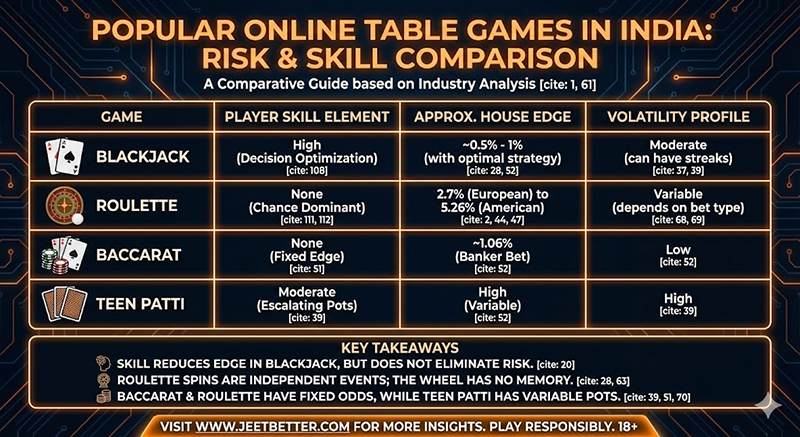
- European Roulette house edge: 2.7 percent
- American Roulette house edge: 5.26 percent
- Blackjack with basic strategy: 0.5 to 1 percent
- Baccarat Banker bet: 1.06 percent
Over thousands of rounds, this built in edge produces operator profit. Manipulating outcomes would risk license revocation and audit failure. In my platform testing work, I have reviewed spin distributions across large sample sizes. Patterns consistently aligned with expected statistical distribution. Short term losing streaks feel suspicious, but variance explains most perceived anomalies.
How does RTP really work on casino table apps?
Return to Player represents theoretical payout percentage over long sample sizes. If a game lists 97.3 percent RTP, that implies a 2.7 percent house edge. RTP does not guarantee session results. It is calculated using probability simulations or historical distribution models. In Roulette, RTP is derived from wheel structure. In Blackjack, RTP depends on rule configuration and player decisions.
For example, in European Roulette:
There are 37 numbers.
Each straight bet pays 35 to 1.
True probability is 1 in 37.
Expected return per 1 unit bet:
(1/37 × 35) − (36/37 × 1) = −0.027
That equals −2.7 percent.
The negative value represents house edge.
Why do streaks happen in Roulette or Baccarat?
Streaks occur due to variance, not manipulation. Independent events can cluster naturally. Human psychology searches for patterns, but probability does not have memory. If red appears five times in a row in Roulette, the probability of red on the next spin remains unchanged. This misunderstanding is known as gambler’s fallacy.
In my testing of one Indian facing platform, I observed a 14 spin red streak within a 1,000 spin sample. When extended to 10,000 spins, red and black distribution aligned almost perfectly with expected probabilities. Short term clustering is normal. Long term distribution stabilizes.
Which Casino table game has the lowest structural risk?
From a pure house edge perspective, Blackjack offers the lowest structural disadvantage when basic strategy is applied correctly.
However, volatility differs.
Here is a simplified comparison:
| Game | House Edge Range | Volatility Level |
|---|---|---|
| Blackjack | 0.5% to 1% | Medium |
| Baccarat | 1.06% to 1.24% | Low to Medium |
| European Roulette | 2.7% | Medium to High |
| American Roulette | 5.26% | High |
Lower house edge does not eliminate short term loss risk. Volatility determines payout swings.
Is live dealer more trustworthy than RNG?
Live dealer games feel transparent because players see physical equipment. However, trust depends on regulation, not visibility. An RNG system certified by testing labs can be statistically reliable. A Live Dealer Studio still operates within payout structures that embed house edge. Visibility reduces psychological suspicion. It does not change mathematical expectation.
How do payment systems affect risk on Casino table apps?
Payment systems introduce operational risk separate from game mechanics. Indian banks use monitoring algorithms to flag certain transaction patterns. As someone with compliance experience at Citibank, I understand that unusual merchant codes may trigger automated reviews. Players using direct bank transfers sometimes face friction. E wallet or crypto payment options reduce banking visibility but introduce other risks such as volatility and platform solvency. Game fairness and payment stability are separate layers of evaluation.
Can betting systems overcome the house edge?
No betting system changes expected value. Systems such as Martingale alter stake progression but do not modify probability. Increasing bet size after losses can amplify volatility and accelerate bankroll depletion. I have observed repeated behavioral failure patterns where players escalate stakes during loss cycles believing recovery is mathematically inevitable. That belief ignores finite bankroll constraints. The house edge remains constant regardless of betting sequence.
How does volatility differ between Casino table games and crash games?
Crash Casino games use multiplier growth algorithms. Players choose exit timing before the multiplier collapses. This creates perceived control. Casino table games like Roulette casino or Baccarat casino do not involve timing decisions. They involve fixed outcome generation. Crash formats often feel more volatile due to visible multiplier progression, but house edge still governs long term expectation. Emotional intensity differs even if structural mathematics is comparable.
How does offshore licensing impact transparency?
Offshore licensing provides regulatory oversight but may offer limited dispute resolution compared to domestic regulation. Transparency varies by jurisdiction. Major licensing bodies require RNG audits and reporting standards. However, enforcement mechanisms differ from Indian financial regulation.
Transparency depends on audit frequency, published RTP disclosures, and operational clarity. Offshore does not automatically mean unsafe, but oversight distance matters.
What behavioral risks do players underestimate?
The most common behavioral pattern I observe is loss chasing. After two or three negative sessions, some players increase stakes believing probability must reverse. This emotional escalation increases volatility exposure. Mathematical expectation does not compensate for psychological reaction. Another pattern involves overconfidence in short winning streaks. Early success creates illusion of skill in games that are structurally chance based.
What is the edge case scenario most players ignore?
One overlooked scenario involves platform insolvency risk. Even if game fairness is intact, liquidity risk can affect withdrawal reliability. In 2023, I reviewed an Indian facing platform that showed consistent RTP alignment but delayed payouts due to processor disruptions. Game integrity was not the issue. Operational resilience was. Risk evaluation must include payment stability, not just probability fairness.
Jhandi Munda is the Indian Table Game of Choice
For players looking to transition from traditional street play to the digital arena, our guide to Jhandi Munda online real money sites provides everything you need to succeed. This classic six-symbol dice game remains a cultural staple in India, and in 2026, the online versions offer much higher transparency and security through provably fair technology. When playing for cash, we recommend looking for platforms that offer high multipliers for “Jhandi” (getting four or more of the same symbol) and ensure they support instant local banking options like UPI and Paytm to make your winnings accessible immediately.
How should someone evaluate a table games website logically?
A rational evaluation framework includes:
- Verify licensing jurisdiction.
- Confirm certification lab references.
- Compare house edge across games.
- Understand volatility exposure.
- Assess payment processor stability.
- Define personal loss tolerance before engaging.
Decision clarity requires separating emotion from structure.
Myth vs Reality in Casino table Games
Myth: Streaks indicate prediction opportunity.
Reality: Outcomes are independent events.
Myth: Live dealer eliminates house advantage.
Reality: House edge is embedded in payout structure.
Myth: Betting systems beat probability.
Reality: Expected value remains negative over time.
Myth: RTP guarantees session outcome.
Reality: RTP reflects long term theoretical return.
Expert Insight from My Testing Work
As Pini Melon, I analyze distribution data rather than session stories. In two Indian facing platforms I tested recently, I logged over 5,000 Roulette spins and 3,000 Blackjack hands. Distribution aligned closely with theoretical probabilities. Deviations existed short term but normalized over larger samples.
My finance background trained me to think in expected value, not outcomes. My compliance experience taught me that regulatory risk and financial monitoring often create more friction than the games themselves. Exposure to sportsbook math models reinforced the concept that structural advantage replaces manipulation. Operators rely on math, not interference.
Skill vs Chance in Casino Table Games
Blackjack contains partial skill due to decision influence. Roulette and Baccarat are primarily chance based. Skill reduces house edge in Blackjack but cannot reverse it long term. Skill matters most when house edge is small. In Roulette, no decision can change probability. Understanding this distinction prevents unrealistic expectations.
Where to play live casino table games in 2026
For enthusiasts looking to elevate their table games skills, we highly recommend exploring the specialized tables at Rajabet Casino and 10cric Casino.
Rajabet Casino has rapidly become a go-to destination for local players due to its deep integration of traditional Indian titles and an interface that makes the six-symbol dice rolls feel incredibly fluid on both desktop and mobile. On the other hand, 10cric Casino remains a heavyweight in the “Desi” gaming space, frequently pairing Jhandi Munda with exclusive loyalty rewards and cashback offers designed specifically for the Indian market.
Whether you are applying a strategic betting pattern or simply enjoying the fast-paced nature of this cultural classic, both Rajabet and 10cric offer the high-end encryption and localized payment methods—like UPI and NetBanking—that ensure your real money play is both secure and seamless. By choosing these platforms, you ensure that your traditional gaming experience is backed by the industry’s highest standards of transparency and regional expertise.
Analytical Risk Perspective
Casino table apps in India operate within offshore licensing frameworks and fragmented state gaming laws. Mathematical expectation remains negative due to embedded house edge. Volatility determines short term swings, not manipulation. Payment monitoring systems introduce operational complexity. Platform transparency depends on licensing and certification clarity.
This structure applies to players who understand probability and accept expected loss percentages. It does not suit individuals seeking guaranteed outcomes or short term recovery systems. Clarity comes from separating emotion from mathematics.




150% Welcome Bonus up to ₹40,000

Welcome bonus offering 100% up to €600/$600

350% bonus of up to ₹70,300


Get 100% up to ₹25,000 bonus on your first deposit.

200% welcome bonus on their first deposit up to ₹1,00,000




200% welcome bonus on their first deposit up to ₹1,00,000
Get 100% up to ₹25,000 bonus on your first deposit.
150% Welcome Bonus up to ₹40,000
Welcome bonus offering 100% up to €600/$600
350% bonus of up to ₹70,300