
Payment Methods in India for Online Casino and Sports Betting in 2026


Quick Summary
In 2026, payment methods for online casino and sports betting in India operate inside a tightly monitored banking ecosystem shaped by RBI oversight, GST on deposits, and transaction pattern analysis.
UPI remains dominant but highly visible. Net Banking, Google Pay, Paytm, VISA cards, and prepaid vouchers each carry different exposure points. In my experience, account freezes are almost always driven by irregular behavior patterns, not by one isolated deposit.
Why I Wrote This Guide
Over the past decade, I have worked inside the two largest global iGaming operators, Entain and Flutter Entertainment. Between 2015 and 2024, I had direct exposure to payment routing, risk scoring systems, fraud prevention models, and how operators localize for markets like India.
When you sit inside those rooms, you see how the system really works. You see how banks respond to regulatory noise. You see how payment aggregators rotate merchant accounts. You see how freeze waves happen.
Most players only see the front end. They see a QR code or a card field. They assume a deposit failed because the casino blocked it. Often, that is not what happened.
This guide reflects what I have observed from both sides of the industry. I am not writing from speculation. I am writing from operational experience.
The Reality of Betting Payments in India Today
If you deposit on an offshore sportsbook targeting India in 2026, the transaction rarely goes directly to the operator.
Instead, it flows through a payment aggregator. That aggregator manages rotating bank accounts, temporary virtual payment addresses, settlement batching, and merchant routing structures. The casino might be licensed offshore, but the Indian leg of the payment runs through domestic banking rails.
That means visibility is built into the process. The Reserve Bank of India does not regulate casinos directly. But it regulates banks. It regulates AML reporting. It regulates suspicious transaction monitoring.
And because of that, the banking system shapes your betting experience more than the gambling regulator does.
The key question is not which method is safe. The key question is where the exposure sits and how consistent your transaction behavior is.
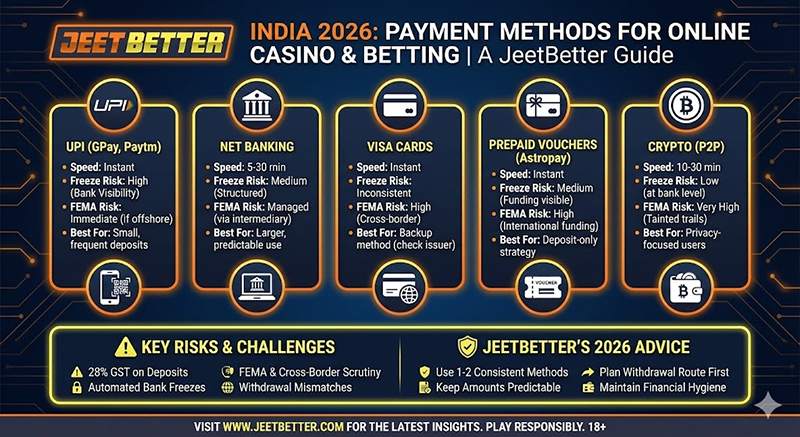
UPI: Fast, Dominant, and Fully Visible
UPI is the backbone of betting deposits in India.
When you send money via UPI system, it runs through NPCI infrastructure. Your bank sees the virtual payment address, the UTR, the amount, and the timing. Even if the transaction description does not show a casino name, internal monitoring systems analyze patterns and clustering. From what I have observed over the years, freezes do not happen because of one ₹3,000 deposit.
They happen when patterns shift. If someone who normally spends domestically suddenly sends five rapid transfers to rotating VPAs within thirty minutes, that can trigger internal scoring. If someone shows no betting activity for months and then suddenly deposits aggressively over a short period, that can trigger review. UPI itself is stable. It is efficient. But it is high visibility. That does not make it dangerous. It makes it sensitive to irregular behavior.
Google Pay and Paytm: Same Rail, Different Interface
I often see players switching from UPI to Google Pay or Paytm thinking they are changing exposure. They are not.
Google Pay and Paytm for casino primarily operate as UPI interfaces. The underlying rail is the same. Your bank still sees a UPI transaction. The monitoring logic does not change because you switched apps.
If a Google Pay transaction for casino fails, in most cases it is not because Google Pay is blocked for betting. It is because the operator’s backend VPA was rotated or flagged.
Switching apps repeatedly in panic sometimes creates more irregular transaction signals than sticking to one consistent method. From a compliance perspective, consistency reduces friction more than app switching.
Net Banking: Transparent and Structured
Net Banking for casino remains one of the most structured methods, especially for larger deposits. When you use Net Banking, you log into your bank portal and authorize a gateway transfer. The bank sees the beneficiary structure clearly. It is fully transparent. That transparency is not automatically negative. But it means your transaction history is cleanly visible.
In my experience reviewing risk models, Net Banking works well when deposits are moderate and predictable. Problems tend to arise when someone sends multiple large transfers within short timeframes or when transaction volume deviates sharply from historical norms. Banks score anomaly more heavily than volume alone. If your activity looks structured and consistent, friction is lower.
VISA Cards: Issuer Rules Matter
Card deposits still appear on many offshore betting sites targeting Indian users. But acceptance is inconsistent.
Most VISA Cards deposits route through international processors. That cross-border element increases friction. Some Indian banks block gambling merchant category codes outright. Others allow small occasional transactions but tighten thresholds during compliance cycles. From what I have seen inside operator dashboards, acceptance rates can swing sharply depending on issuer rule changes.
Full account freezes purely from card usage are less common than temporary card blocks. But repeated international card payments can increase risk scoring. VISA can work. It just should not be relied upon as your only method in 2026.
Prepaid Vouchers and Astropay: Risk Does Not Disappear
Prepaid vouchers like Astropay card for casino change the structure of exposure. Instead of linking your bank directly to the casino at the deposit stage, you first purchase a voucher and then redeem it. That removes direct casino merchant labeling from the deposit moment. However, the funding of the voucher is still visible to your bank. Often it routes through international processors. That introduces different compliance sensitivity, sometimes linked to FEMA considerations.
Another issue I frequently see is withdrawal mismatch. Many prepaid systems are deposit-only. Withdrawals go back to bank accounts or other channels. Players often discover this too late. Prepaid methods shift exposure. They do not eliminate it.
GST Changed More Than Most Players Realize
The 28 percent GST on the full face value of real money gaming deposits changed operator economics significantly. Although the tax is applied at the operator level, it forced routing adjustments, bonus recalibration, and tighter compliance systems. After GST enforcement tightened, I observed aggregator volatility increase. Some banking relationships became unstable. Payment options appeared and disappeared more frequently.
From the player’s perspective, the payment method you choose does not change GST exposure. But it does affect how stable the routing feels.
FEMA and Cross-Border Sensitivity
The Foreign Exchange Management Act governs cross-border financial flows. Domestic UPI transfers are local. But if settlement ultimately links to offshore structures, cumulative behavior may increase scrutiny. International card payments and prepaid voucher funding are sometimes categorized as foreign digital transactions. Repeated high-value outward flows can increase compliance scoring. Most retail users do not face direct enforcement action. What they encounter are temporary reviews or payment failures triggered by automated systems. Again, pattern matters more than one transfer.
Why Accounts Actually Get Frozen
This is where fear often overtakes logic. Accounts are rarely frozen because someone placed one bet. They are frozen because automated systems detect irregular patterns. Common triggers include rapid repeated deposits, sudden spikes in volume, inconsistent identity details, or large withdrawals after minimal deposit history.
In most cases I have reviewed, freezes were temporary and documentation-based. Providing clarification and source of funds resolved them. Banks are not manually watching every bettor. They are running algorithms. Consistency lowers risk more effectively than chasing new methods.
Withdrawal Planning Is Critical
I always advise users to check withdrawal options before depositing. Deposit convenience is meaningless if withdrawal becomes complicated. Cards are often deposit-only. Prepaid vouchers rarely support payouts. UPI withdrawals require matching identity details and completed KYC. From a risk perspective, mismatched names or incomplete KYC cause more friction than the deposit method itself. Think about your exit route first.
My Practical Advice for 2026
After spending nearly a decade inside operator risk systems, my advice is simple. Use one or two consistent payment methods. Keep deposit amounts predictable. Avoid clustering multiple new methods in short periods. Complete KYC early, not at withdrawal time. Keep transaction records. Banks score anomaly. They do not score morality.
Payment instability in India is usually backend routing shifts, not sudden legal bans. Panic switching increases irregular signals. Structure reduces friction.
All Your Favorite Ways to Pay in One Place
At JeetBetter, we make managing your bankroll simple by reviewing the most reliable and fastest transaction options available for Indian players. Whether you prefer the convenience of mobile apps like Paytm Casino and Google Pay for casino transfers, or the universal accessibility of UPI for online casino payments, we have you covered. For those who prioritize traditional security, we offer in-depth guides on using Bank transfer for casino and Net Banking for casino deposits. Additionally, you can explore the benefits of prepaid solutions with the AstroPay Card for casino or stick to the global standard by using a Visa card for casino transactions. Click any of the methods above to find the best-rated sites, deposit limits, and step-by-step tutorials for each.
Final Thoughts
In 2026, payment methods for online casino and sports betting in India exist inside a regulated and monitored financial environment. UPI dominates but is visible. Google Pay and Paytm are UPI interfaces. Net Banking is transparent. VISA depends on issuer rules. Prepaid vouchers shift exposure but do not remove it.
The safest practical approach is behavioral discipline, withdrawal planning, and documentation readiness. There is no invisible rail. But there is predictable behavior. And in my experience, predictable behavior almost always outperforms reactive improvisation.







150% Welcome Bonus up to ₹40,000

Welcome bonus offering 100% up to €600/$600

350% bonus of up to ₹70,300


Get 100% up to ₹25,000 bonus on your first deposit.

200% welcome bonus on their first deposit up to ₹1,00,000




200% welcome bonus on their first deposit up to ₹1,00,000
Get 100% up to ₹25,000 bonus on your first deposit.
150% Welcome Bonus up to ₹40,000
Welcome bonus offering 100% up to €600/$600
350% bonus of up to ₹70,300