
Crash Game Sites 2026: How to Win Analysis | JeetBetter

Quick Summary
Crash game sites in India operate under offshore licensing and function through algorithm driven multiplier systems with a built in house edge. Under current Indian regulatory interpretation, state level laws vary and enforcement focus typically targets operators. The real risk lies in volatility, payment monitoring, and behavioral escalation rather than mechanical rigging.
Introduction
Crash game sites have grown rapidly across the Indian online casino market in the past three years. I have personally tested dozens of Indian facing platforms, reviewed their multiplier engines, examined payment stability, and analyzed behavioral engagement patterns. The rise of crash websites such as Aviator game sites and JetX game sites is not accidental. These games sit at the intersection of algorithmic probability and fast cycle engagement design.
Under current Indian regulatory interpretation, online real money gaming remains fragmented across jurisdictions. State level laws vary. Enforcement focus typically targets operators rather than individual players. Most crash game sites serving Indian users operate under offshore licensing structures rather than Indian regulators. That legal ambiguity influences transparency and payment oversight but does not alter the mathematical core of the game.
As Pini Melon, and drawing on my background in compliance at Citibank, engagement systems at Zynga, and operational exposure to bet365’s sportsbook math models, I approach crash games structurally. My focus is not surface features. It is algorithm design, Return Distribution behavior, volatility clustering, and payment risk exposure.
This analysis is not about promotion. It is about clarity.
Are crash game sites actually legal for Indian users in 2026?
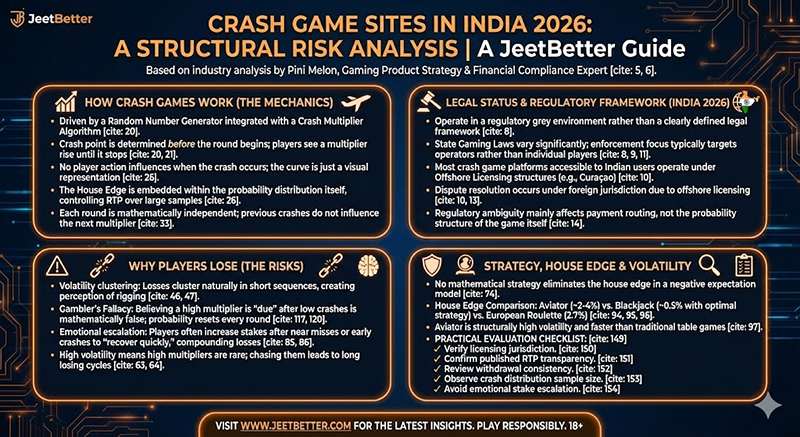
Crash game sites operate in a regulatory grey environment rather than a clearly defined legal framework. Under current Indian regulatory interpretation, online money games are treated differently across states, and enforcement approaches differ significantly. Most crash game platforms accessible to Indian users operate under Offshore Licensing structures, commonly from Curaçao or similar jurisdictions.
In practice, enforcement focus typically targets operators rather than individual players. However, legality can depend on state residency, interpretation of State Gaming Laws, and whether the game is categorized as a Game of Chance or Skill. Crash games are algorithm driven and are generally treated as chance based formats.
From a compliance perspective, which I developed during my time at Citibank, regulatory ambiguity mainly affects payment routing, not the probability structure of the game itself. The multiplier does not change because of geography. Oversight transparency, however, can vary by operator.
How do crash games work mechanically behind the scenes?
Crash games are driven by a Random Number Generator integrated with a Crash Multiplier Algorithm. The system determines the crash point before the round begins. Players see the multiplier rise from 1.00x upward until it stops abruptly. That stop point is pre computed by algorithmic formula, not influenced by player input.
Here is a simplified structural flow of one crash round:
- The server generates a random seed.
- The Crash Multiplier Algorithm applies a probability distribution.
- The crash point is mathematically locked.
- The multiplier begins rising visually on screen.
- Players can cash out before the predetermined crash point.
- When the system reaches the locked crash value, the round ends.
The House Edge is embedded within the probability distribution itself. This means the Return to Player, or RTP, is mathematically controlled over large sample sizes. No mid round adjustment occurs. This model differs from card based games like Teen Patti or Andar Bahar, which rely on Shuffle Algorithm structures and Card Probability mechanics.
Are crash games rigged or manipulated on Indian sites?
Crash games on audited platforms are not manually rigged round by round. The perception of rigging usually arises from volatility clustering, not operator intervention. Certification Labs test Random Number Generator integrity statistically. They verify that the probability distribution matches declared RTP. However, not all platforms publish detailed testing data. Smaller offshore operators may lack transparent certification disclosures. In my own review testing, I have seen two patterns.
On one mid tier Indian facing site, the RTP declaration was visible but no certification reference was provided. On another larger platform with multi market exposure, detailed testing documentation from recognized labs was available. The difference is transparency, not necessarily algorithm integrity. Mathematically, a built in house edge guarantees long term negative expectation. That structural disadvantage is often misinterpreted as rigging.
Is crash primarily luck or does skill matter?
Crash games are predominantly chance driven. The crash point is predetermined by algorithm. A player’s decision to cash out does not influence the probability outcome. Unlike blackjack, where basic strategy can reduce House Edge to near 0.5 percent, crash games do not allow probability optimization.
The only controllable variable is exposure size. Bankroll management is a financial decision, not a skill that alters return distribution. My exposure to sportsbook modeling at bet365 reinforced a core principle: if the probability engine is fixed, no behavioral timing alters expected value. Skill in crash games is limited to risk discipline. It does not modify statistical expectation.
What is the real RTP of crash games on Indian sites?
Crash game RTP typically ranges between 96 percent and 98 percent depending on provider configuration. RTP represents long term theoretical payout across millions of rounds. It does not describe short term experience. If a crash game declares 97 percent RTP, the implied House Edge is 3 percent. Over ₹1,00,000 wagered, the theoretical retention is ₹3,000. That does not mean every session loses 3 percent. Volatility determines distribution of outcomes. High volatility games can produce large wins early and extended losing streaks later. RTP is an average across massive samples, not a guarantee per user.
Why do crash games produce so many low multipliers?
Low multipliers occur more frequently because of probability skew. The crash distribution is designed so that small multipliers such as 1.05x or 1.20x appear often, while extreme outcomes like 100x are rare.
This produces clustering patterns that feel unfair. However, independence remains intact. Each round’s probability is separate from the previous round. This is where Gambler’s Fallacy emerges. After five low crashes, many assume a high multiplier is due. In reality, probability resets every round. Mathematically, streaks occur naturally within independent sequences.
How volatile are crash games compared to table games?
Crash games are significantly more volatile than European Roulette or basic strategy Blackjack. Volatility measures how widely actual outcomes deviate from expected value in short term play.
Below is a simplified structural comparison:
| Game | Typical House Edge | Volatility Level |
|---|---|---|
| European Roulette | 2.7% | Medium |
| Blackjack | 0.5% to 1% | Low to Medium |
| Baccarat Banker | 1.06% | Low |
| Crash Games | 2% to 4% | High |
Crash games produce wider swings due to rare high multipliers combined with frequent small losses.
Can crash multipliers be predicted using patterns?
Crash multipliers cannot be predicted through pattern charts or trend tracking. The Crash Multiplier Algorithm is independent each round. Visual graphs display historical values but do not influence future probability. From my Zynga experience in engagement mechanics, I recognize how visual feedback loops encourage pattern recognition bias. Humans are wired to detect patterns even in random sequences. That bias fuels prediction myths.
Statistically, no strategy changes expected return.
Are live crash games more transparent than standard ones?
Live crash games may operate within a Live Dealer Studio environment visually, but the multiplier logic remains algorithm driven. Unlike live card games where a Shuffle Algorithm and physical dealing are visible, crash remains formula based. Transparency increases when platforms publish Certification Labs verification. Live display improves perception, not probability structure.
Do platforms adjust crash outcomes based on player wins?
Crash outcomes are not adjusted based on individual player performance on regulated platforms. The algorithm applies uniformly to all participants within the round. However, payment monitoring systems may track unusual deposit or withdrawal patterns. That is risk management, not multiplier manipulation. From a compliance standpoint, which I observed in financial institutions, risk controls operate outside gameplay probability engines.
How does crash compare to Teen Patti or Andar Bahar?
Teen Patti and Andar Bahar rely on card distribution probabilities. Crash relies on exponential multiplier growth. Card games have structured payout tables and visible dealing sequences. Crash compresses risk into time based escalation. Emotionally, crash feels faster and more intense. Volatility in crash games is typically higher due to extreme outcome potential.
What role does Offshore Licensing play in transparency?
Offshore Licensing determines regulatory oversight jurisdiction. It does not change the mathematical structure of crash algorithms, but it affects dispute resolution, certification disclosure, and compliance reporting standards. In my platform testing, larger operators with multi market presence often publish clearer RTP and lab verification details. Smaller sites sometimes omit certification transparency. Licensing impacts accountability more than algorithm design.
How do deposits and withdrawals affect crash game risk?
Crash games themselves are probability models. Financial risk expands through payment channels. Many Indian facing sites use UPI gateways, wallet transfers, or crypto rails. Frequent gambling related transactions may trigger bank monitoring under anti money laundering frameworks. This does not automatically imply penalty but increases review probability. Understanding payment stability is as important as understanding RTP.
Why do crash games feel more addictive than table games?
Crash games compress event cycles into seconds. Each round ends quickly, creating rapid reinforcement loops. This mirrors engagement models I studied at Zynga where short cycle feedback increases retention. Near miss experiences strengthen emotional attachment. When a player misses a 10x multiplier by seconds, psychological reinforcement intensifies. This structural speed differentiates crash from slower formats like baccarat.
What is a common behavioral failure pattern in crash games?
A common failure pattern is progressive stake escalation after consecutive low multipliers. Players assume a large multiplier is due and increase bet size accordingly. This compounds exposure just before random probability resets. When another low multiplier appears, losses magnify. I have observed this pattern repeatedly in review testing logs. The underlying math does not compensate for emotional escalation.
What is an edge case scenario players rarely consider?
An overlooked scenario involves temporary payment freezes due to unusual transaction velocity. A player may win a large multiplier and attempt rapid withdrawal cycles. Bank risk systems may flag high frequency gambling transactions. The issue is not gameplay fairness but financial compliance friction. Understanding this distinction prevents misattributing payment review to rigged gameplay.
How should someone evaluate a crash game site rationally?
A rational evaluation includes:
- Verify Offshore Licensing transparency.
- Confirm RTP disclosure and certification.
- Review payment method stability.
- Examine withdrawal reliability history.
- Understand declared House Edge.
- Recognize volatility profile.
- Set predefined exposure limits.
The decision should be structural, not emotional.
Recommended Crash Game Sites
For those looking to master the high-speed thrills of Aviator and JetX, we highly recommend exploring established industry leaders like Casino Days and 10cric Casino.
In 2026, CasinoDays has become a top destination for crash enthusiasts due to its lightning-fast UPI withdrawal system—often processing in under 10 minutes—and its massive library that seamlessly integrates the Aviator social betting interface. Meanwhile, 10cric Casino remains a powerhouse for the Indian market, offering specialized “Desi” promotions that often include free bets specifically for crash games. Whether you are using a conservative auto-cashout strategy or hunting for a 100x moonshot, both Casino Days and 10cric provide the high-tier security and localized banking options (like Paytm and PhonePe) that ensure your focus stays on the rising multiplier and not on your transaction status.
Analytical Risk Perspective
Crash game sites in India operate within regulatory ambiguity shaped by offshore licensing and state level legal fragmentation. The mathematical expectation remains negative due to embedded House Edge within the Crash Multiplier Algorithm. Volatility produces sharp distribution swings that amplify emotional response. Transparency depends more on licensing jurisdiction and certification disclosure than on the visible multiplier itself. Payment stability and bank monitoring frameworks introduce secondary risk layers beyond gameplay probability.
As Pini Melon, drawing on compliance experience at Citibank, engagement mechanics exposure at Zynga, and sportsbook modeling insights from bet365 environments, I view crash games as high volatility probability engines rather than strategic systems. Decision clarity emerges from understanding RTP, volatility, legal complexity, and financial friction before participation.


150% Welcome Bonus up to ₹40,000

Welcome bonus offering 100% up to €600/$600

350% bonus of up to ₹70,300


Get 100% up to ₹25,000 bonus on your first deposit.

200% welcome bonus on their first deposit up to ₹1,00,000




200% welcome bonus on their first deposit up to ₹1,00,000
Get 100% up to ₹25,000 bonus on your first deposit.
150% Welcome Bonus up to ₹40,000
Welcome bonus offering 100% up to €600/$600
350% bonus of up to ₹70,300