
Opening Summary
In 2026, Telegram has moved beyond being a simple messaging alternative to become a critical infrastructure layer in India. For users, businesses, and the gaming community, it offers a decentralized ecosystem through “Mini Apps” and native payment integration. However, this growth has invited unprecedented regulatory scrutiny under the IT Rules 2026 and the Cinematograph (Amendment) Act 2023. Users now face a complex landscape of “Digital Arrest” scams and sophisticated financial “Task Scams” that require expert navigation. This guide, written from the perspective of a financial and technology analyst, provides a strategic roadmap for leveraging Telegram safely in the current Indian digital climate.
The 2026 Landscape: From Chat App to Indian Infrastructure
Having spent years in the risk and compliance departments at Citibank and analyzing game economies at Zynga, I have witnessed how platforms transition from niche tools to essential utilities. In 2026, Telegram in India is no longer just “the other” chat app. It has evolved into a shadow economy.
The Great Pivot from WhatsApp to “Mini Apps”
While WhatsApp remains the dominant carrier for casual text, the Indian power user has pivoted to Telegram for its “Mini Apps” and interactive bot architecture. This shift is driven by the frictionless nature of Telegram’s API, which allows developers to launch full-scale applications, from stock trading interfaces to live gaming, directly within a chat window. In my research at GijimaMedia, we’ve observed that the Indian market is particularly receptive to this because it bypasses the heavy storage requirements of traditional Android apps.
Telegram Bots: The Backbone of the 2026 Ecosystem
In my current work as an analyst at JeetBetter, I spend a significant amount of time testing how users interact with bot-driven products. In 2026, bots are the primary way Indians interact with the platform.
The Evolution of Bot Utility
Telegram bots have moved past simple automated replies. They now serve as:
- Gaming Hubs: I have personally researched how Telegram functions as a distribution layer for games in markets where traditional apps face restrictions.
- Customer Support: Most major Indian fintechs now use verified bots to handle tier-one queries.
- Educational Tools: Bots that deliver real-time exam notifications or study materials for UPSC and JEE are massive in 2026.
The Safety Protocol for Bots
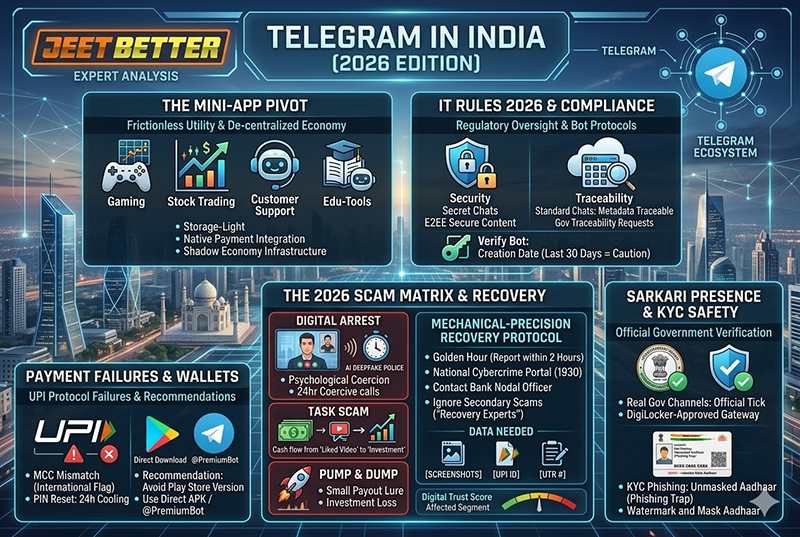
However, the ease of creating a bot makes it a playground for data-harvesting tools. If a bot asks for your PAN or Aadhaar for “verification” outside of a government-approved gateway like DigiLocker, it is a phishing attempt. My rule of thumb: check the bot’s “Info” section; if it was created within the last 30 days, treat it with extreme caution.
Telegram Wallets: Navigating Payments and UPI in 2026
One of the most frequent questions I encounter involves payment failures. In 2026, UPI is the lifeblood of Telegram in India, but it is fraught with technical hurdles.
Understanding UPI Failures and MCC Mismatch
Failures typically stem from a Merchant Category Code (MCC) mismatch. When you initiate a transaction for Telegram “Stars” or Premium, your bank’s fraud detection system may flag the merchant as a high-risk international entity, especially if the payment is routed through a foreign aggregator.
The “Cooling Period” and Handshake Errors
Banks now enforce a 24-hour freeze on high-value digital goods if you have recently reset your UPI PIN. Furthermore, using a VPN can cause a geo-mismatch during the NPCI handshake, leading to an immediate “Decline” error. To bypass these issues, I recommend the Telegram Direct version or the @PremiumBot, which often supports local Indian cards and UPI handles better than the standard app store versions.
Telegram Sarkari: Official Government Presence and Verification
In 2026, the term “Sarkari” (Government) has become a double-edged sword on Telegram. While the government uses the platform for dissemination, scammers use the “Sarkari” label to appear legitimate.
Verified Government Nodes
Under the IT Rules 2026, legitimate government channels must carry an “Official” verification tick. The Ministry of Information and Broadcasting (MIB) uses Nodal Officers to monitor large public groups for piracy and compliance. If a channel claims to be a government job portal but lacks this tick, it is likely a phishing site designed to steal your Demat or banking logins.
The KYC Scam Trap
Telegram itself does not require Aadhaar or PAN for usage. If a bot claiming to be a “Sarkari” service asks for unmasked copies of your ID, it is a scam aimed at identity theft. Scammers collect these details to open Mule Bank Accounts or take out “Instant Loans” in your name. Always use a Masked Aadhaar and add a digital watermark for protection.
Privacy and the Law: Understanding India’s IT Act 2026
The regulatory environment has tightened significantly. As an analyst who has worked in regulated financial environments at Citibank, I pay close attention to internal controls and risk.
Encryption vs. Traceability
While Secret Chats use end-to-end encryption (E2EE), standard group chats are stored in the cloud. Under the IT Rules 2026, the Indian government can request “traceability” for messages that incite violence or affect national security. They can identify who you spoke to and when, even if they cannot easily read the E2EE content.
The “Digital Trust Score” and SIM Binding
The Department of Telecommunications (DoT) has implemented “SIM Binding,” linking your Telegram account more tightly to your physical SIM card. Furthermore, being a member of groups flagged for piracy—specifically those sharing copyrighted content from platforms like JioCinema or Netflix—can lower your “Digital Trust Score” in future regulatory frameworks.
The Scam Landscape: Digital Arrests and Task Scams
The most harrowing trend of 2026 is the “Digital Arrest” scam. This involves scammers using AI-generated deepfakes to impersonate high-ranking police officers from Delhi or Mumbai.
Psychological Coercion
Scammers claim a suspicious package containing drugs was found in your name. They force victims to stay on a Telegram video call for hours—a “digital arrest”—to prevent them from contacting real authorities. They then coerce victims into transferring “bail money” via UPI or IMPS.
The Analyst’s Perspective on Financial Scams
At JeetBetter, I analyze user experience and payout clarity. I’ve noticed that “Task Scams”, where you are paid small amounts for liking videos before being asked to “invest”, are the #1 cause of financial loss. These are “Pump and Dump” schemes where anonymous admins inflate prices or vanish with “investments”.
Telegram Scam Recovery: The 2026 Protocol
If you lose money on Telegram in 2026, you must act with mechanical precision.
The “Golden Hour”
Your best chance for recovery is reporting the transaction within the first two hours, the “Golden Hour”. Report to the National Cybercrime Reporting Portal (1930) immediately. Banks can sometimes freeze the recipient’s account if the fraud is reported instantly, but once the money is moved to crypto or a mule account, it is nearly impossible to retrieve.
The Trap of “Recovery Experts”
Do not believe accounts on Telegram claiming to be “Recovery Experts” who can get your money back for a fee. These are Secondary Scams targeting people who have already been duped. Instead, take screenshots of the chat, the scammer’s UPI ID, and the transaction reference number (UTR) and provide them to your bank’s Nodal Officer.
Expert Comparisons: Spotting a Scam vs. a Real Service
| Feature | Verified Service/Bot | Scam/Phishing Bot |
|---|---|---|
| Verification | Blue “Official” Tick | No Tick; often uses stolen logos |
| ID Requirement | DigiLocker or Official Gateway | Asks for PAN/Aadhaar photos directly |
| Payment Method | Native UPI Handshake | Asks for direct transfers to personal UPI IDs |
| Communication | Professional, no pressure | High-pressure, “Digital Arrest” threats |
| Age of Bot | Established (Check Info) | Created within the last 30 days |
Final Recommendations for 2026
As someone who balances analytical reporting at GijimaMedia with practical gaming research, I recommend a layered security approach.
- Passcode Lock: Enable Telegram’s “Local Passcode” and “Auto-Lock” to encrypt your local database.
- Privacy Settings: Change “Who can add me to groups” to “My Contacts” to avoid stock market and task scams.
- Hide Phone Number: Set your phone number to be hidden from “Everybody” to prevent scraping by copyright enforcement or scam bots.
Official Versions: Avoid “Modded” apps like Bgram or Vidogram; they often contain hidden spyware and can lead to your device ID being blacklisted by ISPs, affecting your access to banking apps like YONO.
Frequently Asked Questions
In 2026, UPI failures on Telegram typically stem from the Merchant Category Code (MCC) mismatch or the “cooling period” enforced by Indian banks. When you initiate a transaction, your bank’s fraud detection system may flag Telegram as a high-risk international merchant, especially if the payment is routed through a foreign aggregator. Common technical triggers include using a VPN, which causes a geo-mismatch during the NPCI handshake, or hitting the daily ₹1 lakh UPI limit. Additionally, if you recently reset your UPI PIN, banks impose a 24-hour freeze on high-value digital goods. Always check if your bank has “International Transactions” enabled, as some Telegram billing nodes are processed outside India. To bypass these persistent errors, avoid using the Telegram app from the Play Store and download the Telegram Direct version from the official website, as it uses a more flexible payment gateway. Alternatively, use the @PremiumBot directly within the app; it often supports local Indian cards and UPI handles that the standard Google Play billing system rejects due to ongoing service fee disputes.
While the Ministry of Information and Broadcasting (MIB) recently ordered the removal of over 3,000 piracy channels under the Cinematograph (Amendment) Act 2023, the legal risk for a passive member is low but increasing. The government now uses Nodal Officers to monitor large public groups. If a group is flagged for distributing copyrighted content from platforms like JioCinema or Netflix, it can be nuked within three hours. Under Sections 6AA and 6AB, the focus is on “uploaders” and “distributors” who face up to three years in jail. However, being part of a group under “Digital Observation” could link your phone number to a database of pirated content consumers, potentially affecting your “Digital Trust Score” in future regulatory frameworks. To protect yourself, exit any group that lacks an “Official” verification tick and frequently shares “Direct Download” links for new theatrical releases. In 2026, Indian ISPs are increasingly using Deep Packet Inspection (DPI) to log access to known piracy bot signatures.
This is a “Digital Arrest” scam, a major threat in India as of 2026. No Indian law enforcement agency, whether it is the CBI, Mumbai Police, or Narcotics Bureau, will ever conduct an “arrest” or a “legal hearing” over a Telegram or WhatsApp video call. Scammers use AI-generated deepfakes and high-quality virtual backgrounds of police stations to intimidate victims. They claim a “suspicious package” containing drugs was found in your name or that your Aadhaar is linked to money laundering. They will “digitally arrest” you by forcing you to stay on camera for hours while they coerce you into transferring “bail money” or “clearance fees” via UPI or IMPS. If you receive such a call, do not argue; simply hang up and block the account. Real police will physically visit your registered address or send an official summons via post. Immediately report the handle to the National Cybercrime Reporting Portal (1930).
These groups are usually “Pump and Dump” scams where anonymous admins push penny stocks to inflate prices. In 2026, scammers use automated scrapers to find Indian numbers from leaked databases. To stop this, go to Settings > Privacy and Security > Groups & Channels and change the “Who can add me” setting from “Everybody” to “My Contacts”. This is the single most effective way to prevent being added to fraudulent investment schemes. If you are already in such a group, avoid clicking any links, as they often lead to phishing sites designed to steal your Demat account credentials or banking logins. If you’ve been added to a group named after a famous entity like “ICICI Direct” or “Zerodha,” check the member list. In 2026, SEBI has made it mandatory for registered advisors to provide their RERA/SEBI registration number in the group description. Cross-verify this number on the official SEBI website.
Telegram itself does not require Aadhaar or PAN for standard usage. If a bot or a channel admin asks for these documents for “verification,” “job processing,” or “prize distribution,” it is a phishing attempt. In 2026, “Identity Theft” via Telegram is rampant, where scammers collect your KYC details to open Mule Bank Accounts or take out “Instant Loans” in your name. Once they have your PAN and Aadhaar photo, they can bypass many basic verification layers in the Indian fintech ecosystem. Legitimate Indian services will use a secure, government-approved DigiLocker or an official gateway, never a random Telegram bot message. Never upload unmasked copies of your Aadhaar. If you must provide ID, use the “Masked Aadhaar” (where only the last 4 digits are visible) and add a digital watermark across the image saying “For [Company Name] Verification Only – [Date]”.
“Task Scams” are the #1 cause of financial loss on Telegram in India in 2026. Once you transfer money to a “merchant” UPI ID, it is moved through a chain of accounts within minutes. Your best chance for recovery is to report the transaction on the National Cybercrime Portal (cybercrime.gov.in) or call 1930 within the “Golden Hour” (the first two hours). Banks can sometimes “freeze” the recipient’s account if the fraud is reported immediately. However, once the money is withdrawn at an ATM or converted to crypto, recovery is nearly impossible. Do not believe “Recovery Experts” on Telegram who claim they can get your money back for a fee; these are Secondary Scams. To increase your chances of a successful bank chargeback, take screenshots of the chat, the scammer’s UPI ID, and the transaction reference number (UTR) and provide these to your bank’s Nodal Officer.
Telegram’s Secret Chats use end-to-end encryption (E2EE), meaning the messages are stored only on the sender’s and receiver’s devices, not on Telegram’s servers. However, standard chats (including groups) are not E2EE by default; they are stored in Telegram’s cloud. In 2026, under the updated IT Rules, the Indian government can request metadata or “traceability” for messages that incite violence or affect national security. While they cannot easily read E2EE Secret Chats, they can identify who you spoke to and when. For maximum privacy in India, use Telegram’s “Local Passcode” feature and enable “Auto-Lock” to encrypt the local database on your phone. Additionally, use the “Self-Destruct Timer” in Secret Chats. Be aware that in 2026, the Department of Telecommunications (DoT) has implemented “SIM Binding,” making your Telegram account more tightly linked to your physical SIM card.
Telegram’s automated anti-spam AI in India is extremely aggressive due to the surge in bot activity. You might get banned if you send unsolicited links to multiple people who haven’t saved your number, join and leave 10+ groups in an hour, or use a “Virtual Number” (VoIP) to register. Indian mobile operators now report “suspicious SIM behavior” to platforms. If your account is “Limited,” you can’t message strangers, which usually happens if multiple Indian users click “Report Spam” on your messages. A “Permanent Ban” follows if you are flagged for distributing copyrighted or prohibited material. If you are a genuine user, use the @SpamBot to check your status and submit an appeal. Ensure your Two-Step Verification (2FA) is active, as many bans are due to account hijacking where your account was used to send spam without your knowledge.
Finding legitimate remote work on Telegram in India is difficult because the platform is a breeding ground for “HR Impersonation” scams. Scammers use stolen logos of companies like Amazon, Wipro, or Flipkart. A major red flag is any job that requires you to pay a “Security Deposit,” “Laptop Delivery Fee,” or “Training Charge”. Legitimate Indian companies will never conduct a recruitment process entirely on Telegram; they use official email domains and LinkedIn. In 2026, fake “AI Training” jobs are popular, where users are tricked into clicking phishing links. Always request a Video Interview on a professional platform like Google Meet or Zoom before accepting any “Telegram-based” job. Use tools like Truecaller to check if the recruiter’s number is marked as “Scam”. It is safer to find leads on official Digital India portals and use Telegram only for secondary team communication.
Using modified versions of Telegram (APKs) is highly risky in the 2026 Indian digital landscape. While these apps offer “Ghost Mode” or “Custom Themes,” they often contain hidden spyware or “Token Stealers”. These malicious scripts can read your chats, steal your contacts, and even intercept SMS-based OTPs for your bank accounts. Since the Indian government started blocking harmful APK IDs in early 2026, using these apps might also lead to your device ID being “Blacklisted” by local ISPs, making it impossible to use official banking or government apps like YONO or Umang on that specific phone. Stick to the official Telegram app or the Telegram Direct APK from telegram.org. If you have already used a modded app, immediately change your Telegram 2FA password, terminate all sessions, and perform a Factory Reset on your phone.