Using Astropay Card India for betting? Learn how deposits work, why bank freezes happen, and how to reduce risk under RBI rules in 2026.

Astropay Card for Online Casino and Sports Betting in 2026

India market analysis for Astropay card: Payment Risks, RBI Oversight and Account Freeze Reality Explained

Quick Summary
Astropay Card remains a usable prepaid deposit method for offshore online casinos in India in 2026, but it does not eliminate Reserve Bank of India monitoring or account freeze risk. The main exposure occurs when funding the voucher through your bank. Moderate transaction patterns, completed KYC, and clear documentation reduce risk more effectively than switching payment brands.
Who Is Writing This and Why It Matters
This analysis is written by Michael Kapil, Senior Market Analyst and User Acquisition specialist at JeetBetter.
Michael spent four years at Entain and another four years at Flutter Entertainment, observing how global operators assess Indian traffic, payment routing risks, and chargeback exposure. Since 2024, he has focused specifically on Indian payment infrastructure, including UPI integration, prepaid voucher flows, wallet intermediaries, and crypto rails. He has witnessed freeze waves, aggregator disruptions, and sudden banking partner exits affecting Indian users. This article reflects observed payment behavior patterns and compliance responses, not marketing claims. AstroPay is great for privacy, but using Google Pay for deposits offers a more integrated experience for Android users
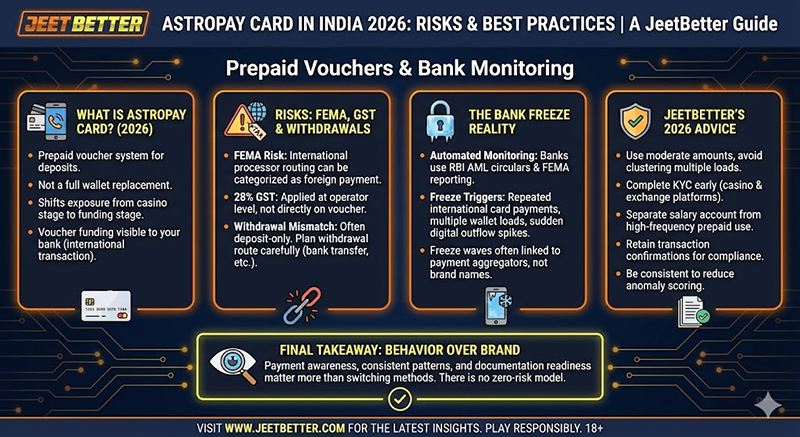
What Is Astropay Card and How Does It Actually Work for Indian Betting in 2026?
Astropay Card is a prepaid voucher system that allows deposits without directly linking your bank account to the casino at the moment of deposit. However, the initial purchase of the voucher remains visible to your bank. It is deposit focused, not a full wallet replacement.
In practical terms, the process works in two steps:
- You purchase a voucher in a chosen currency.
- You redeem the code at the casino cashier page.
From a risk management perspective, operators prefer prepaid vouchers because they eliminate chargeback exposure. Once redeemed, funds cannot be reversed. This protects casinos from card disputes. From a banking compliance perspective, prepaid vouchers are treated as higher risk instruments under global AML frameworks. The Reserve Bank of India does not regulate Astropay directly, but banks apply RBI circular driven monitoring systems that evaluate international digital wallet loads and unusual card purchases. The key point is this: Astropay shifts exposure from the casino stage to the funding stage. It does not remove oversight. If you prefer using a physical card over a virtual one, check out our guide to Visa card payments for Indian players.
Is Astropay Legal for Online Betting in India?
Astropay itself is a prepaid payment instrument and is not classified as a gambling platform. Indian law does not prohibit holding or purchasing prepaid vouchers. However, using it to fund offshore betting sites may operate in regulatory grey zones depending on state law interpretations and the broader framework under the Promotion and Regulation of Online Gaming discussions. The Ministry of Finance has focused primarily on taxation and AML enforcement rather than criminalizing payment instruments. Enforcement actions historically target operators more often than individual users. Legal exposure tends to be linked to transaction scale and behavior patterns rather than the specific payment method brand.
Why Do Indian Bank Accounts Get Frozen After Astropay Transactions?
Accounts are frozen because of transaction patterns, not because the word “Astropay” appears on a statement. Banks use automated monitoring systems influenced by RBI AML circulars and FEMA reporting requirements.
Common triggers include:
- Repeated international card payments
- Multiple wallet loads in short time periods
- Sudden increase in outward digital transactions
- Combined inward and outward cross border flows
In 2024 and 2025, freeze waves were often linked to payment aggregators flagged internally by banks. When an aggregator lost a banking partner, users saw temporary debit blocks. Astropay funding transactions may appear as foreign digital services or payment processing charges. The merchant descriptor does not determine risk alone. Behavior does.
How Does FEMA Affect Astropay Transactions?
The Foreign Exchange Management Act regulates cross border financial flows. When an Astropay voucher purchase routes through an international processor, it can be categorized as a foreign payment. Banks assess cumulative outward remittance behavior. Small occasional purchases rarely escalate. Repeated high value transactions routed internationally may attract compliance review. FEMA exposure does not automatically imply wrongdoing. It increases reporting visibility. Players should understand that prepaid vouchers are often funded through foreign acquiring networks, even if the casino targets Indian users.
Does GST Apply When Using Astropay for Casino Deposits?
The GST Council imposed a 28 percent levy on the full face value of real money gaming deposits. This tax is charged at the operator level. Players do not see a separate GST line on their bank statement when purchasing Astropay. However, operators adjust bonus models and pricing structures to reflect tax impact. Income tax obligations on winnings remain separate and fall under broader income reporting rules. The GST regime affects operators directly but indirectly influences player cost structures.
Is Astropay Safer Than UPI for Betting Deposits?
Astropay reduces direct merchant labeling exposure at the deposit stage. UPI Payment creates a clear domestic transaction trail under NPCI oversight. However, Astropay funding still routes through bank monitored channels. UPI is domestic and highly traceable. Astropay is international and subject to FEMA visibility. Neither eliminates compliance exposure.
The difference lies in structure:
- UPI exposes the deposit stage clearly.
- Astropay exposes the funding stage clearly.
Risk shifts. It does not disappear.
How Do Offshore Casinos Process Astropay Deposits?
Most offshore casinos operating under Curacao licenses integrate prepaid vouchers through payment aggregators. These aggregators manage multiple merchant accounts to reduce chargeback risk. Astropay transactions are typically instant. Once the code is redeemed, funds are credited and irreversible. Operators prefer prepaid deposits because they eliminate refund disputes. This improves their internal risk scoring and banking stability. However, when aggregators change banking partners, deposit acceptance may temporarily fluctuate. Payment routing evolution is constant in the Indian market.
What Is the Safest Practical Way to Use Astropay in India?
There is no zero risk model. However, lower risk patterns are associated with moderation and documentation readiness.
Step by step approach to reduce freeze risk:
- Avoid purchasing large denomination vouchers immediately after inactivity.
- Spread transactions rather than clustering multiple loads in one day.
- Keep KYC completed on both casino and exchange platforms.
- Avoid mixing salary account funds with high frequency prepaid purchases.
- Retain transaction confirmations for compliance queries.
- Do not combine multiple international wallet funding sources simultaneously.
Banks look for anomalies. Consistency reduces anomaly scoring.
How Does Astropay Compare to Other Payment Methods in India 2026?
| Method | Speed | Freeze Risk | KYC Level | Reversal Risk | Best For | 2026 Stability |
|---|---|---|---|---|---|---|
| UPI | Instant | Medium to High | Bank KYC | Low | Small frequent deposits | Moderate |
| Bank Transfer | 5 to 30 min | Medium | Full Bank | Low | Larger structured use | Moderate |
| E Wallets | Instant | Medium | Wallet KYC | Medium | Flexible daily use | Variable |
| Crypto | 10 to 30 min | Low at bank level | Exchange KYC | Irreversible | Privacy focused users | High |
| Astropay Voucher | Instant | Medium | Low to Medium | None | Deposit only strategy | Moderate |
Freeze risk refers to bank action, not casino blocking.
Does Astropay Require KYC in India?
Basic voucher purchases may not require detailed identity verification. However, repeated high value transactions can trigger enhanced due diligence under AML frameworks. Indian banks already hold your KYC under RBI guidelines. Casinos require KYC before processing withdrawals. Prepaid instruments are considered higher AML risk categories internationally. Expect additional verification if transaction volume increases. Compliance requests are usually document based, not punitive.
What Withdrawal Challenges Exist With Astropay?
Astropay is primarily deposit focused. Most offshore casinos do not process withdrawals back to prepaid vouchers. This creates a structural issue. You deposit through Astropay but withdraw through bank transfer, wallet, or crypto. This mismatch may raise compliance questions if large withdrawals appear after international prepaid funding patterns. Players often misunderstand this limitation. It should be confirmed before depositing.
Have Payment Patterns Changed Since 2023?
Yes. Following GST changes and Ministry of Finance scrutiny, operators diversified payment routing. UPI remains dominant but prepaid voucher use increased during periods of aggressive bank flagging. Crypto adoption grew among higher value users seeking structural separation from domestic rails. Michael Kapil observed aggregator banking partner shifts during freeze waves in 2024 and 2025. Payment routing evolution is ongoing and reactive. Stability depends on operator compliance maturity.
Frequently Asked Questions About Payment Methods in India
Can I use Astropay Card to deposit on Indian casino sites in 2026?
Yes, Astropay Card can be used on some offshore casino and sports betting sites that accept prepaid vouchers. It is not integrated with Indian banks or UPI directly. Transactions usually route through international processors. Because funds are prepaid, your bank statement will not show a betting merchant name, but funding the card may still be traceable under RBI monitoring rules.
Is Astropay legal for online betting in India?
Astropay itself is a prepaid payment instrument, not a gambling platform. Indian law does not specifically ban holding or using such vouchers. However, using it for real money betting may fall into grey areas depending on state laws and the Promotion and Regulation of Online Gaming Act framework. Enforcement risk depends more on transaction patterns than the payment brand.
Can my bank account be frozen if I buy an Astropay Card for betting?
Yes, freezes can happen if the funding transaction is flagged by your bank’s compliance system. Banks monitor unusual international wallet loads under RBI and FEMA guidelines. If your debit card purchase appears linked to high risk merchants, temporary debit restrictions may occur. Prepaid cards reduce direct exposure, but the initial funding step is still visible.
Does Astropay show gambling on my bank statement?
Usually no, it shows as a payment processor or digital services charge. The descriptor typically reflects Astropay or its processing partner rather than a casino name. However, banks analyze merchant category codes and transaction behavior, not only text descriptions. Repeated wallet loads combined with gambling outflows may still trigger compliance reviews.
How do I withdraw winnings to Astropay in India?
Most casinos allow deposits via Astropay but do not process withdrawals back to prepaid vouchers. Withdrawals often require bank transfer, crypto, or another wallet. This creates a traceability gap. Before depositing, confirm withdrawal options. Many players misunderstand this and later face difficulty when they cannot reverse funds back to the original voucher.
How long does Astropay deposit processing take?
Deposits are usually instant once the voucher code is entered correctly. The casino credits funds immediately if the payment gateway is functioning normally. Delays typically occur due to incorrect code entry, expired vouchers, or casino internal risk checks. Astropay itself does not hold funds after redemption, since it operates on prepaid balance logic.
Why was my Astropay transaction declined?
Declines commonly occur due to expired voucher codes, incorrect currency selection, or casino level payment restrictions. In some cases, Indian debit card transactions used to purchase the voucher are blocked by the issuing bank. RBI compliance filters and international merchant risk scoring can prevent successful wallet funding before the casino step even begins.
Is Astropay safer than UPI for betting deposits?
Astropay reduces direct linkage between your bank and the betting operator. However, it does not eliminate risk. UPI transactions are domestic and highly traceable under NPCI oversight. Astropay funding often involves international routing, which can trigger FEMA compliance monitoring. Risk exposure differs in structure, not necessarily in severity.
Will I have to pay GST on casino withdrawals via Astropay?
Currently, GST at 28 percent applies to the face value of online real money gaming deposits under GST Council rules. It is not directly charged on withdrawals. However, operators may factor GST into pricing models. Astropay itself does not deduct GST separately. Tax reporting obligations depend on income classification under Indian tax law.
Does Astropay require KYC verification in India?
Basic voucher purchases often do not require full KYC. However, large value transactions or repeated purchases may trigger identity verification under global AML standards. Indian banks funding the voucher purchase will already have KYC under RBI norms. Casinos also require KYC before processing withdrawals, regardless of the deposit method used.
Can I use Astropay with UPI in India?
No, Astropay is not directly integrated with UPI rails. You typically purchase vouchers using debit cards or other supported payment methods. UPI is regulated by NPCI and operates domestically, while Astropay is an international prepaid instrument. Any indirect link would occur only at the stage of funding through your bank.
Is Astropay better than crypto for betting payments?
Crypto provides pseudonymous transfers and allows withdrawals back to the same asset. Astropay is prepaid and usually deposit only. However, crypto transactions are visible on blockchain explorers and exchanges apply KYC under Indian AML rules. Both carry compliance risk. The difference lies in traceability structure and volatility exposure.
Can Astropay purchases trigger FEMA compliance issues?
Yes, international wallet funding can fall under FEMA monitoring if cross border elements are detected. Banks assess outward remittance patterns, especially repeated payments to foreign processors. While small retail transactions rarely escalate, high frequency activity may trigger compliance queries. Documentation requests are based on pattern recognition, not the voucher name itself.
What limits apply to Astropay Card transactions in India?
Limits depend on the voucher denomination and the issuing channel. Some platforms cap maximum purchase amounts per day. Indian banks may also impose international transaction ceilings. There is no RBI published limit specific to Astropay, but general debit card foreign transaction limits apply based on your bank’s risk policies.
Can casinos block my account if I use Astropay?
Yes, operators can restrict accounts if payment patterns raise AML concerns. Multiple prepaid deposits combined with inconsistent KYC data often trigger enhanced due diligence. Astropay itself does not cause blocking, but prepaid instruments are considered higher risk in global compliance frameworks. Always ensure your identity documents match your casino account details.
Is Astropay accepted by major Indian betting sites?
Most India facing offshore sportsbooks and casinos accept Astropay, especially those targeting Latin America and Asia. However, acceptance varies by currency and region. It is less common on platforms that focus heavily on UPI or direct INR banking. Always confirm on the cashier page before purchasing a voucher.
Can I lose money due to currency conversion when using Astropay?
Yes, currency mismatch can cause conversion fees. If you buy a voucher in USD but deposit into an INR wallet, exchange rate spreads apply. International card funding may also add foreign transaction charges. Indian banks often charge a markup over interbank rates, which increases total cost beyond the face value.
What documents might a bank ask for if transactions are flagged?
Banks may request clarification of transaction purpose, proof of source of funds, or additional identity confirmation. Under RBI AML guidelines, unusual digital wallet funding patterns can prompt temporary debit restrictions. Providing clear explanations and maintaining consistent transaction history reduces escalation risk. Freezes are typically precautionary, not permanent penalties.
Can Astropay help avoid salary account freezes?
It reduces direct merchant tagging but does not guarantee protection. Salary accounts flagged for unusual foreign digital wallet loads can still face temporary restrictions. Many players choose secondary accounts to manage transaction segregation. Banks assess risk based on behavior patterns, transaction size, and frequency, not only merchant descriptors.
Is Astropay still viable for Indian betting in 2026?
Yes, it remains usable on many offshore platforms, but regulatory pressure has increased. Indian banking surveillance, GST reporting frameworks, and cross border payment monitoring are tighter in 2026. Astropay works as a prepaid intermediary, yet it should be viewed as a payment tool with compliance exposure, not a shield against oversight.
Final Analysis
Astropay Card remains a functional deposit method for Indian betting in 2026, but it operates inside a highly monitored financial ecosystem shaped by RBI AML systems, FEMA oversight, and GST enforcement. Risk is determined by behavior, not branding. Payment awareness, consistent patterns, completed verification, and documentation readiness matter more than switching between UPI, vouchers, or crypto. JeetBetter’s position remains analytical and responsible. Understanding how systems function allows players to make informed decisions in an evolving regulatory environment.
Learn about Google Pay Casino Sites
Explore Upi Casino Sites
More on Bank Transfer Casino Sites
Check out Paytm Casino Sites
More on Net Banking Casino Sites
Discover Visa Casino Sites tips
Top – Indian Casinos

150% Welcome Bonus up to ₹40,000

Welcome bonus offering 100% up to €600/$600

350% bonus of up to ₹70,300

Get 200% Welcome Bonus up to ₹1 Lakh + ₹500 Free Bet

Get 100% up to ₹25,000 bonus on your first deposit.

200% welcome bonus on their first deposit up to ₹1,00,000




Top Rated Casinos
200% welcome bonus on their first deposit up to ₹1,00,000
Get 200% Welcome Bonus up to ₹1 Lakh + ₹500 Free Bet
Get 100% up to ₹25,000 bonus on your first deposit.
150% Welcome Bonus up to ₹40,000
Welcome bonus offering 100% up to €600/$600
350% bonus of up to ₹70,300