Google Pay India betting guide for 2026. Understand RBI monitoring, account freeze risk and safer UPI deposit practices with JeetBetter insights.

Google Pay for Online Casino and Sports Betting in 2026


UPI Monitoring, RBI Oversight and Account Freeze Risk Explained
Quick Summary
Google Pay works for online casino and sports betting deposits in India in 2026 because it runs on UPI, which is fully integrated with your bank account. Under Reserve Bank of India monitoring frameworks, transactions are highly traceable and freeze risk is driven by patterns, not single deposits. Moderate amounts, completed KYC, and predictable behavior are safer than switching between apps or payment brands.
Who Is Behind This Analysis and Why It Matters
This analysis reflects the work and industry background of Michael Kapil, Senior Market Analyst at JeetBetter.
Michael spent eight years inside Entain and Flutter Entertainment, the two largest global iGaming operators. That experience provided a behind the scenes understanding of how operators manage Indian payment risk, how UPI integrations are structured, and how freeze waves often follow banking partner changes. His specialization in Indian market localization and payment infrastructure, including UPI, NetBanking and digital wallets, directly informs this article.
What you are reading is shaped by observed payment disruptions, compliance tightening after GST changes, aggregator shifts, and internal operator risk assessments. It is not a promotional overview. It is a structural explanation of how Google Pay works within India’s regulated financial system in 2026.
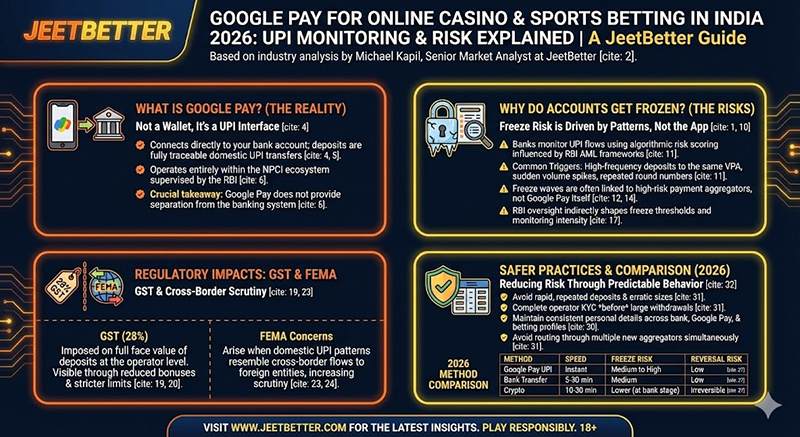
What Is Google Pay in the Context of Indian Betting Payments?
Google Pay is not an independent wallet in India. It is a UPI interface that connects directly to your bank account.
When you deposit on a betting site using Google Pay, the transaction is processed as a UPI transfer. The money moves instantly from your bank account to a Virtual Payment Address displayed by the operator or its payment aggregator. The deposit may appear seamless on your screen, but from a banking perspective, it is a fully traceable domestic transfer. This distinction matters because many players assume Google Pay provides separation from the banking system. It does not. It operates entirely within the UPI ecosystem governed by NPCI and supervised indirectly by the Reserve Bank of India.
In 2026, UPI remains one of the most monitored payment rails in India. Banks apply algorithmic transaction monitoring aligned with RBI AML circulars. That means Google Pay deposits are analyzed under the same frameworks as any other UPI transfer. Understanding this structure is essential before discussing safety or freeze risk.
Can You Use Google Pay to Deposit on Casino and Betting Sites in 2026?
Yes, you can use Google Pay when the betting site supports UPI deposits. If the cashier displays UPI as a payment method, Google Pay can process the transaction instantly from your linked bank account.
However, acceptance depends on the operator’s payment aggregator. Many offshore sportsbooks operate under licenses such as Curacao, Malta MGA, Anjouan or Tuvalu, and integrate Indian payments through local intermediaries. These intermediaries provide rotating VPAs to manage banking relationships and reduce chargeback risk.
Deposit success depends on several layers:
- Your bank approving the UPI transfer
- The VPA being active and not flagged
- Aggregator settlement stability
- Operator compliance thresholds
In periods following Ministry of Finance or GST Council announcements, payment channels may change quickly. Users sometimes misinterpret this as a Google Pay issue. In reality, it is often aggregator rotation or banking partner disruption. Google Pay itself is rarely the source of failure. The infrastructure behind the UPI handle determines reliability.
Why Do Indian Bank Accounts Get Frozen After Google Pay Betting Transactions?
Accounts are frozen because of transaction patterns, not because the app name is Google Pay. Banks monitor UPI flows using risk scoring systems influenced by RBI guidelines and AML frameworks. Common triggers include:
- High frequency deposits to the same VPA
- Sudden volume spikes after long inactivity
- Repeated round numbered transfers
- Clusters of deposits followed by large inward credits
During 2024 and 2025, freeze waves were often linked to specific payment aggregators that banks internally classified as high risk. When such classification occurs, multiple users may experience temporary debit restrictions at the same time. A freeze usually means outgoing payments are paused while compliance teams review activity. Banks may request clarification, source of funds details, or confirmation that transactions were authorized. The key point is that Google Pay does not cause freezes. Behavior patterns interacting with monitored payment rails do.
Is Google Pay Safer Than PhonePe or Paytm for Betting Deposits?
No. Google Pay, PhonePe and Paytm all operate on UPI. The underlying rail is identical. Switching apps does not change traceability. NPCI sets UPI standards. Banks implement monitoring aligned with RBI frameworks. The merchant routing behind the VPA and your transaction behavior matter more than the interface used. Some users rotate apps believing it lowers risk. In practice, the bank sees UPI transfers regardless of which front end you use. What reduces risk is consistency and moderation, not app switching. Many Indian players find that Paytm casino transactions are a great alternative if they encounter any issues with GPay.
How Does RBI Oversight Influence Google Pay Betting Activity?
The Reserve Bank of India regulates banks and payment systems, not casinos directly. However, its circulars define AML expectations and suspicious transaction monitoring frameworks. Banks must monitor unusual digital payment patterns. UPI logs provide structured, searchable transaction data. If activity fits internal high risk indicators, accounts may be flagged for review.
RBI oversight indirectly shapes:
- Freeze thresholds
- Documentation requests
- Monitoring intensity after regulatory announcements
Following the GST Council’s 28 percent tax decision on online real money gaming deposits, banks increased sensitivity toward high frequency gaming related UPI flows. Oversight is systemic, not personal. It is applied algorithmically across millions of accounts.
How Does GST at 28 Percent Affect Google Pay Deposits?
The GST Council imposed a 28 percent levy on the full face value of online real money gaming deposits. This tax is paid by the operator, not directly deducted from your Google Pay transfer.
However, the effect is visible indirectly:
- Reduced bonus structures
- Stricter deposit limits
- Increased KYC enforcement
- More cautious payment routing
Operators operating under Curacao or other offshore licenses must account for Indian GST exposure when targeting Indian players. This has led to payment infrastructure tightening and more frequent routing adjustments. You do not pay GST separately through Google Pay, but the ecosystem you are depositing into has absorbed significant tax pressure.
How Does FEMA Interact With Google Pay Betting Payments?
Google Pay transactions are domestic UPI transfers. However, offshore operators may route settlement through structures linked to foreign entities. FEMA concerns arise when transaction patterns resemble cross border value movement. For example, if banks detect repeated flows to accounts tied indirectly to foreign gaming groups, scrutiny can increase.
Retail scale users typically experience this as payment failures or temporary account reviews, not direct FEMA notices. The Foreign Exchange Management Act influences how banks classify and report cross linked transactions. Even when using domestic UPI, the underlying commercial structure matters. Since GPay runs on the UPI network, it is worth comparing it against other best UPI casino sites available today
How Do Offshore Operators Process Google Pay Deposits?
Offshore operators integrate Google Pay through UPI aggregators. These aggregators manage multiple bank accounts and VPAs.
Key objectives for operators:
- Reduce chargeback exposure
- Replace blocked accounts quickly
- Maintain settlement continuity
- Protect banking relationships
UPI deposits are irreversible once completed. Unlike card payments, they do not carry traditional chargeback risk. This makes them attractive to operators but increases finality for players. When an aggregator loses a banking partner, deposits may fail temporarily. This is often misinterpreted as a Google Pay technical problem. Payment routing evolution is constant in India’s gaming market.
How Does Google Pay Compare to Other Betting Payment Methods in 2026?
| Method | Speed | Freeze Risk | KYC Level | Reversal Risk | Best For | 2026 Stability |
|---|---|---|---|---|---|---|
| Google Pay UPI | Instant | Medium to High | Bank KYC | Low | Small structured deposits | Moderate |
| Bank Transfer | 5 to 30 min | Medium | Full Bank | Low | Larger controlled deposits | Moderate |
| E Wallets | Instant | Medium | Wallet KYC | Medium | Flexible daily transactions | Variable |
| Crypto | 10 to 30 min | Lower at bank stage | Exchange KYC | Irreversible | Structural separation users | High |
| Prepaid Vouchers | Instant | Medium | Low to Medium | None | Deposit only strategy | Moderate |
Google Pay is convenient but highly visible at the bank level. Crypto reduces direct bank exposure but shifts visibility to exchanges and blockchain records.
What Are the Main KYC Triggers When Using Google Pay?
KYC friction usually arises during withdrawal, not deposit.
Common triggers:
- Name mismatch between bank account and betting profile
- Multiple payment methods linked to one account
- Large withdrawals after small deposits
- Sudden activity spikes
- Device or IP inconsistencies
Banks already hold your KYC under RBI requirements. Operators require their own KYC verification before releasing funds. Misalignment between the two systems creates delays. Consistency between bank name, Google Pay profile, and betting account is essential.
How Can You Reduce Account Freeze Risk When Using Google Pay?
Direct answer: reduce unpredictability.
Practical steps:
- Avoid rapid repeated deposits within short timeframes.
- Keep deposit sizes consistent rather than erratic.
- Complete operator KYC before requesting large withdrawals.
- Avoid combining UPI, crypto and prepaid vouchers in short succession.
- Maintain separate documentation for discretionary online activity.
- Respond promptly to bank compliance queries.
- Avoid routing deposits through multiple new aggregators simultaneously.
Banks flag anomalies. Predictable behavior reduces anomaly scoring.
Is Google Pay Safer Than Crypto for Indian Betting?
It is safer in terms of volatility and ease of recovery if minor errors occur. It is less private in terms of banking traceability.
Crypto reduces direct bank exposure during deposit but introduces:
- Exchange KYC
- Blockchain transparency
- Conversion volatility
- Regulatory monitoring by the Ministry of Finance
Choosing between Google Pay and crypto is choosing where compliance visibility occurs.
Frequently Asked Questions About Payment Methods in India
Can I use Google Pay to deposit on casino and betting sites in India in 2026?
Yes, Google Pay can be used for deposits when the betting site supports UPI payments. Google Pay is a UPI app, so the money moves from your linked bank account to the payment handle shown by the site. The payment is usually instant, but it is fully traceable under bank monitoring. If a site shows only cards or crypto, Google Pay will not work.
Can I withdraw winnings to Google Pay in India?
Usually no, not directly to Google Pay as a separate wallet. Most withdrawals go to your bank account, and Google Pay only shows that bank account and UPI activity. If the betting site offers UPI payouts, it is typically a credit to the same bank account you linked in Google Pay. Some sites block UPI withdrawals unless your KYC is completed and the name matches.
Is Google Pay safer than UPI, or is it the same thing?
It is basically the same rail. Google Pay runs on UPI, so the risk profile is driven by UPI and your bank, not the app brand. NPCI sets UPI rules and banks apply compliance monitoring under RBI expectations. Switching from PhonePe to Google Pay rarely changes traceability. What changes risk most is your transaction pattern and the merchant routing used by the operator.
Can my bank account be frozen if I use Google Pay for betting deposits?
Yes, it can happen. Freezes usually come from pattern based alerts, like repeated deposits to the same payment handles, sudden spikes in volume, or transactions linked to high risk processors. Banks monitor UPI behavior and may pause outgoing payments while they review activity. A freeze is often temporary and may lead to questions or document requests, not an automatic penalty.
Why do Google Pay betting payments sometimes get declined?
Most declines are not Google Pay issues. They happen due to bank risk controls, daily UPI limits, UPI downtime, or the payment handle being blocked or rotated by the operator. Sometimes the recipient account is flagged, which causes failures even if your bank is fine. If your UPI PIN is correct and balance is enough, try later or use a different method offered by the cashier.
Will my bank statement show gambling if I pay with Google Pay?
It usually will not show a casino brand name. It will show a UPI transfer, often with a VPA, merchant name, or a payment processor descriptor. That still gives banks a clear trail. Banks look at behavior patterns, not only the text label. If deposits are frequent and clustered, they can score as higher risk even without obvious gambling words.
Is it risky to use my salary account with Google Pay for betting deposits?
Yes, it can be riskier in practice. Salary accounts often have predictable inflows and regular bill patterns, so sudden high frequency UPI transfers to unfamiliar recipients stand out more. Many users prefer separating discretionary online spending from salary flows to reduce compliance friction. This is about avoiding unusual patterns that trigger automated checks.
https://www.youtube.com/watch?v=SC1fVrm5gIw
Does GST apply when I deposit using Google Pay?
GST at 28 percent applies to the full face value of deposits for online real money gaming at the operator level. You do not typically pay GST as a separate line item through Google Pay. Instead, the operator’s pricing and wallet rules reflect that tax burden.
Do I have to pay GST on withdrawals to my bank via Google Pay?
GST is not typically charged on withdrawals as a separate payment tax. Withdrawals are usually transfers from the operator to your bank account. Income tax treatment of winnings is separate and independent of whether you used Google Pay.
How fast are Google Pay deposits and withdrawals for betting sites?
Deposits via Google Pay UPI are usually instant. Withdrawals are rarely instant and depend on operator risk checks and banking partners. Delays occur when KYC is incomplete or names do not match.
Is Google Pay accepted on most offshore betting sites targeting India?
Many offshore sportsbooks accept UPI, so Google Pay often works if UPI is shown in the cashier. Acceptance can change due to aggregator rotation and banking partner disruptions.
What KYC checks can be triggered if I use Google Pay for deposits?
Payment patterns can trigger enhanced checks. Triggers include high withdrawals, inconsistent personal details, device changes, and multiple payment sources. Name mismatch is common friction.
Can Google Pay transactions be reversed if something goes wrong?
UPI transfers are not traditional chargeback instruments. Reversal options are limited. Once credited by the operator, disputes usually move to customer support rather than banking chargeback.
Are there FEMA concerns when using Google Pay for offshore betting?
Sometimes, when routing resembles cross border flows or when banks detect foreign linkages behind local aggregators. Most cases appear as payment failure or account review rather than formal enforcement.
Is Google Pay safer than crypto for Indian betting payments?
It is safer in terms of price stability, but more traceable at the bank level. Crypto shifts compliance visibility to exchanges and blockchain records.
Why do some sites ask for a UPI collect request and does Google Pay still support it?
Collect request mechanisms have been tightened under evolving UPI rules. If flow changes, it may reflect NPCI policy updates rather than operator behavior.
Can using Google Pay for betting trigger suspicious transaction reporting?
Yes, if patterns trigger AML monitoring systems under RBI frameworks. Reporting does not automatically imply wrongdoing, but it increases scrutiny.
What documents might my bank ask for if Google Pay betting activity is flagged?
Banks may request transaction clarification, source of funds confirmation, or identity re verification. These are compliance driven requests.
How can I reduce risk when using Google Pay for betting deposits?
Keep deposit sizes moderate, avoid rapid repeated transfers, complete KYC before withdrawals, and maintain consistent personal details across accounts.
What is the biggest beginner mistake with Google Pay deposits on betting sites?
The biggest mistake is assuming Google Pay hides activity. It does not. It is a UPI interface linked directly to your bank account.
Final Perspective
Google Pay is convenient and widely accepted for betting deposits in India, but it operates entirely within a highly monitored UPI framework. RBI oversight, GST enforcement, and evolving AML expectations mean payment behavior matters more than app selection. No method eliminates compliance visibility. Risk management depends on moderation, documentation readiness, and structural understanding. JeetBetter’s position remains analytical and responsible. Clear understanding of how Google Pay integrates with India’s financial system allows users to approach betting payments with awareness rather than assumption. Recommended online casino for Google Pay payment is: 10Cric Casino
More on Casino Astropay Card Sites
More on Upi Casino Sites
Learn about Bank Transfer Casino Sites
Check out Net Banking Casino Sites
Learn about Paytm Casino Sites
More on Visa Casino Sites
Top – Indian Casinos

150% Welcome Bonus up to ₹40,000

Welcome bonus offering 100% up to €600/$600

350% bonus of up to ₹70,300

Get 200% Welcome Bonus up to ₹1 Lakh + ₹500 Free Bet

Get 100% up to ₹25,000 bonus on your first deposit.

200% welcome bonus on their first deposit up to ₹1,00,000




Top Rated Casinos
200% welcome bonus on their first deposit up to ₹1,00,000
Get 200% Welcome Bonus up to ₹1 Lakh + ₹500 Free Bet
Get 100% up to ₹25,000 bonus on your first deposit.
150% Welcome Bonus up to ₹40,000
Welcome bonus offering 100% up to €600/$600
350% bonus of up to ₹70,300